
 The Question That Shapes a Marriage
Every generation of Muslim singles faces the same question: which is more important—love or compatibility? In the noise of modern life, with social media ideals, cultural pressures, and endless options, the answer often gets lost. Yet the choice shapes everything: your happiness, your faith, and your future family.
Today’s Muslim communities in the West face a complex marriage landscape. Delayed marriages, rising divorce, and unsafe online spaces make the path harder than it should be. Romance fraud alone cost UK victims over £106 million in 2024, according to City of London Police. Against this backdrop, a trusted, Shariah-compliant, and community-focused approach is not just helpful; it is essential. Muslim Marriage Services (MMS), a Certified Social Enterprise founded in 2018 and launched in 2023, responds to these realities with a values-first platform that blends Islamic principles with robust digital safety.
What Do We Mean by Love and Compatibility?
Before choosing what to prioritise, we must define terms. Love is powerful. It can inspire patience, generosity, and mercy. In an Islamic frame, love in marriage sits alongside compassion and tranquillity—mawadda and rahma. It grows through kindness, trust, good character, and shared gratitude. It is not just a feeling; it is also a practice.
Compatibility, however, is the fit between two people’s values, beliefs, lifestyles, and goals. It includes faith level and practice, commitment to family life, temperament, conflict style, financial habits, and life ambitions. It also includes pragmatic matters like location, career plans, and the desire for children. Compatibility turns attraction into an enduring partnership. It makes the daily rhythm of a marriage peaceful and sustainable.
Love can start a journey, but compatibility sustains it. You can adore someone and still struggle if your values clash at every turn. Likewise, a good match without warmth can feel dry and distant. Neither extreme is wise. For Muslims seeking nikah, the question is not “love or compatibility” but “how much weight to give each at each stage.”
The Cost of Confusing Priorities in the West
The Muslim Marriage Crisis is real. In Britain, around 42% of Muslim marriages end in divorce; in North America, the rate exceeds 30% as of early 1990s statistics. Many are waiting longer to marry due to career demands, cultural pressures, and limited halal spaces to meet. Meanwhile, the rise of unsafe platforms with weak identity checks exposes users to manipulation and fraud, leaving emotional harm in its wake.
When people place love above all else at the start, they often ignore serious red flags. Later, unresolved differences become painful. On the other hand, when families push for a purely functional match with no emotional warmth, couples struggle to bond. They may marry but feel lonely. In both cases, the result is fragile: one shock—job loss, illness, family conflict—can shake the foundation.
This is why MMS prioritises trust and safety from the very first click. With full identity verification via Yoti, a global leader and Certified B Corporation, members meet each other with dignity and confidence. MMS then pairs this safety with guidance, education, and an Islamic framework so couples can evaluate both love and compatibility with wisdom. It is not either/or. It is both/and—with clarity.
A Simple Framework: Before, During, and After Nikah
To decide which is more important, consider timing.
Before marriage: prioritise compatibility and character. During the search, ask yourself: Do our values align? Do we share a vision of faith, family, and work? Can we solve problems together? The Prophet’s guidance to prioritise deen and character still holds practical power today. Love matters, but at this stage, it must support—not replace—clear-headed assessment. Infatuation fades. Good character does not.
In the early years of marriage: invest in communication and respect. Once you say “qabul,” you build intimacy, not just attraction. Love becomes actionable: listening well, negotiating fairly, apologising quickly, and celebrating each other’s efforts. Compatibility makes this work easier because your daily habits and priorities match more often. Still, love softens the edges and turns compromises into shared victories.
In later years: deepen shared purpose. Careers change. Children grow. Health shifts. Here, both love and compatibility must mature. Couples who chose well at the start find that their alignment lets them adapt. And couples who nurture love through service and gratitude find their bond becomes a source of sakina (tranquillity) in a turbulent world. One without the other strains. Together, they compound.
Safety and Trust Turn Compatibility Into Reality
Compatibility is only meaningful if you can explore it safely. In today’s digital age, that requires more than good intentions. It requires strong tools. MMS enforces digital ID verification through Yoti for every member, reducing fraud and deception. Additionally, the DynamIQ Guardian option introduces a trusted mahram or guardian to observe interactions, adding a protective layer that supports transparency while preserving user autonomy.
ProfileShield enables secure profile sharing, including optional guardian approval, so that sensitive information moves carefully—not carelessly. These features support both men and women by raising standards, deterring predatory behaviour, and dignifying serious candidates. They also help families feel confident when supporting a match.
Under the leadership of the MMS Guardian Council (MGC)—guided by a respected female Shariah scholar and global family solicitor with over 20 years’ experience—MMS keeps every process Shariah-compliant, balanced, and inclusive. Women’s voices are central to decisions. The Council also engages with Christian communities to foster shared values and cultural sensitivity. Led by Hajji Mostafa, MMS stands for trust, security, and innovation—because the ummah deserves excellence in ethical matchmaking.
How to Assess Compatibility Without Killing Romance
People often worry that careful evaluation will “ruin the spark.” It does not. Done well, it protects you from heartbreak and helps love grow in the right soil. Here are practical ways to assess compatibility while honouring emotions.
Start with faith and values. Ask each other: How do you practise daily worship? What does taqwa mean in your life? How do you seek knowledge? If you disagree, can you respect each other’s path? Your deen anchors your shared future. If this area has tension from the start, storms may follow.
Discuss life goals early. Where do you plan to live? How do you view work-life balance? What is your outlook on having children? Do you want to support parents or relatives in old age? These choices shape your time, your finances, and your stress. Aligning now avoids resentment later.
Talk about money with calm honesty. What is your approach to spending, saving, and debt? How will you split financial responsibilities? What do you consider a fair mahr? Financial clarity builds trust. When needed, MMS’ Marriage Fund can assist those unable to afford wedding costs, ensuring money does not block a halal union.
Explore family culture and boundaries.
What role will extended family play? How will you handle differences in customs? Do you expect to host often or keep a quieter home? Healthy marriages respect each partner’s roots while forming a new household identity.
Understand communication and conflict styles. How do you react under stress? Do you withdraw or argue? Can you apologise? What triggers you, and what soothes you? Couples who can repair quickly after a disagreement stay connected over time. This skill can be learned through pre- and post-marital education.
Schedule structured conversations. Use MMS’ education resources to guide discussions on rights and responsibilities, intimacy, roles, expectations, and faith practices. Keep your language gentle. Keep your aim unity. You can use simple British English explanations to make complex ideas easier for both families.
Case Windows: Three Stories, One Lesson
Aisha and Omar had strong chemistry. They laughed for hours and felt seen. But they never discussed money. A year into marriage, their visions clashed. He loved generosity without spreadsheets; she needed detailed budgeting to feel safe. With coaching, they agreed a transparent plan. Their love survived because they built compatibility later. It took work, but they grew.
Layla and Haris built on shared values from the start. They agreed on prayer, family time, and living close to parents. Romance felt quieter in the beginning, but respect ran deep. Over time, their affection bloomed through small acts—tea after Fajr, weekly walks, handwritten duas. Their compatibility gave love space to expand.
Sara and Jamal looked perfect on paper. Same field, same city, same diet, same schedule. But they avoided honest talks about faith practice and expectations for children. When these issues surfaced, the gap was wide. Without shared principles, the surface match faded. They needed either serious reconciliation or a brave decision to part. They learned that compatibility is more than lifestyle—it is the backbone of purpose.
Which Is More Important? A Clear, Balanced Answer
So, love vs compatibility—which should you prioritise? The honest answer depends on the stage.
During the search, prioritise compatibility and character. This is where you say no to red flags, yes to alignment, and maybe to potential. If you cannot agree on core values and life direction, love will struggle. If your rhythms constantly collide, daily life will exhaust you. At this stage, compatibility carries more weight, because it predicts stability.
Inside the marriage, grow love deliberately. Once you choose wisely, invest in tenderness. Choose mercy over ego, curiosity over assumption, and gratitude over criticism. Love then becomes the energy that fuels patience and joy. It helps you navigate the inevitable tests. At this stage, love’s quality often determines the warmth of the home.
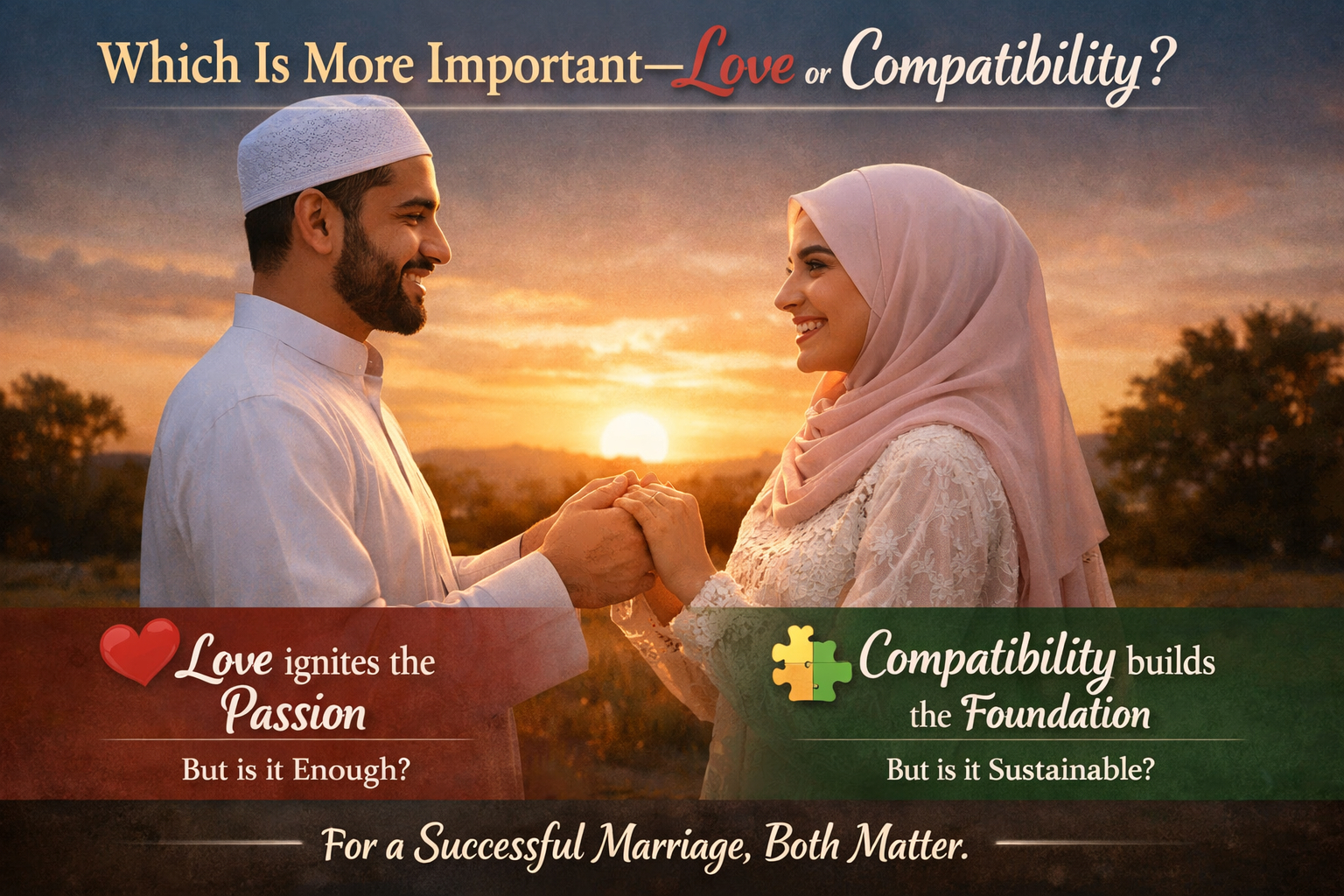
In short: choose on compatibility, live with love. Compatibility builds the house; love makes it a home. Islam already teaches this balance: good character, shared values, and mutual rights ensure justice; tenderness, compassion, and playfulness nurture affection. Both matter. But their priority shifts with time.
From Principles to Protection: How MMS Balances Both
A sound philosophy needs strong practice. MMS translates principles into safeguards, guidance, and tools that work in real life. Here is how.
Trust at the core: Every member verifies their identity through Yoti. This reduces deception and sets a serious tone. People behave better when accountability exists. You can enter conversations with confidence.
Structured safety: DynamIQ Guardian allows optional mahram oversight to deter predatory behaviour and support transparent communication. ProfileShield lets you share your profile securely and involve a guardian when helpful. These features dignify both sides of the match.
Education by design: MMS partners with counsellors to offer pre- and post-marital courses and coaching grounded in Islamic principles and modern research. You learn how to communicate, resolve conflict, set boundaries, and understand rights and responsibilities. You do not just find a spouse; you build a marriage.
Clear, halal autonomy: You engage on your terms. You retain choice and control while navigating an ethical, Shariah-compliant environment. This reduces cultural pressure and unrealistic expectations. It also removes the wrong financial incentives.
Community investment
As a Certified Social Enterprise, MMS reinvests in the ummah through a Marriage Fund for those who cannot afford wedding costs and through ongoing educational initiatives. The MMS Guardian Council ensures expert oversight, with women’s voices at the centre.
Practical Steps You Can Take This Week You can act now. Even small steps move you forward.
- Write your non-negotiables. Limit them to faith, values, and life direction. Keep the list short and honest.
- Draft your “nice-to-haves.” Be flexible. Preferences are not principles.
- Prepare six key questions: deen practice, family expectations, finance, children, careers, and conflict style. Ask them early. Listen fully.
- Share a week-in-the-life snapshot. Compare schedules and routines. Compatibility hides in calendars.
- Invite trusted input. Use a mahram or guardian—via DynamIQ Guardian if you like—to provide perspective and safety.
- Try a pre-marital class. Learn skills now. It is easier than unlearning habits later.
- Keep adab at every step. Be clear, kind, and timely. Close doors respectfully if it is not a fit.
- Protect your privacy. Use ProfileShield for secure sharing and optional guardian approval.
You can discuss sensitive topics in simple British English and still be precise, fair, and dignified. Clear language makes difficult conversations easier for both sides and both families.
Why “Feelings First” Fails—and “Facts Only” Drains
Some say, “Follow your heart completely.” Others say, “Treat marriage like a checklist.” Both extremes miss the point. A heart without guidance can stray; a list without warmth can harden. Islam charts the middle: choose well, then love well.
When people put feelings first, they often excuse patterns that will harm the marriage: dishonesty, irresponsibility, or disregard for faith. Over time, the cost is high. However, when people treat marriage as a deal with no emotional life, they struggle to build closeness. They live together but do not grow together. Balance wins. The best matches feel right and make sense.
The Special Role of Character
Character threads through both love and compatibility. Good character turns compatibility into kindness. It also turns love into loyalty. A spouse who prays for you, forgives you, and protects your honour builds a sanctuary. You can face crises with unity. When choosing, look for sincerity, humility, and truthfulness. These traits outlast looks, status, and trends.
If you find someone with sound deen, aligned values, and gentle character, give the connection time to warm. Love often deepens with safety. It may start as respect and blossom into affection. Real love is planted, watered, and tended.
The Wider Picture: Community Health and Financial Reality
Marriage is personal, but it also shapes the ummah. Strong families model faith for children, stabilise communities, and reduce loneliness. However, financial pressure makes marriage feel out of reach for many. Rising costs—for weddings and living—cause delays or debt. This is why practical support matters.
MMS reduces barriers by removing harmful financial incentives from the process and by offering a Marriage Fund for those in need. The platform also addresses the risk landscape of modern dating by verifying every member and promoting ethical engagement. In a world where romance fraud is growing, especially online, these measures protect dignity and restore trust.
Answering the Question with Confidence Having weighed the evidence, here is the takeaway.
- Before marriage, compatibility is more important than love. It predicts stability and peace.
- After marriage, love becomes more important day to day. It transforms duty into joy.
- Throughout, character ties both together. It keeps love honest and compatibility humane.
Therefore, when you choose a spouse, prioritise shared values, deen, and life direction. Confirm that your temperaments can work. Then nurture love through gentle words, small acts, and daily mercy. This sequence—compatibility first, love continually—gives you the best chance of lasting sakina.
The MMS Promise: From First Salam to Lasting Sakina
MMS exists to support that sequence. It blends Islamic principles with advanced safety and practical education:
- Certified Social Enterprise status ensures community benefit guides every decision.
- Shariah-compliant processes—overseen by the Guardian Council—maintain integrity.
- Yoti-powered ID verification strengthens trust from the start.
- DynamIQ Guardian and ProfileShield protect your journey without taking away autonomy.
- Islamic Compatibility Matching and user autonomy respect both values and choice.
- Education and support—before and after marriage—build real skills.
- The Marriage Fund helps those facing financial barriers.
- Engagement with Christian communities fosters shared understanding and respect.
Led by Hajji Mostafa, with women’s voices central to governance, MMS is more than a platform; it is a movement to resolve the Muslim Marriage Crisis by empowering young Muslims (18–30) to marry well, safely, and wisely.
Your Next Step
If you are weighing love vs compatibility today, you are already asking the right question. Now set a clear plan. Define your core values. Learn how to communicate with respect. Involve a trusted guardian. Use verified, ethical tools. Seek knowledge. Then walk with tawakkul.
Choose with compatibility. Live with love. Build with character. And let mercy be your signature. Insha’Allah, the home you create will be a place of tranquillity—for you, for your children, and for the community that grows around you.