
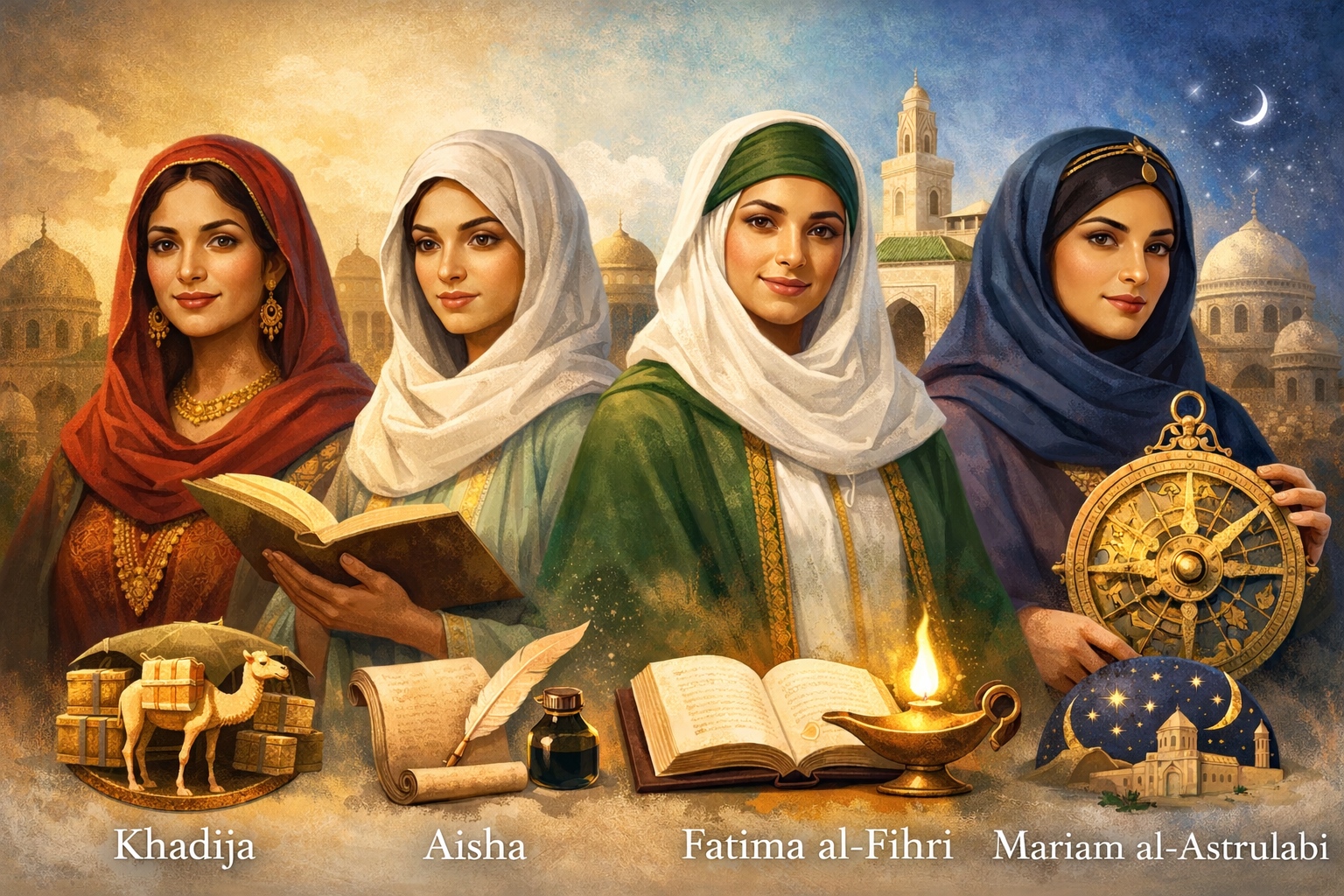
 In this blog, we challenge gender stereotypes by spotlighting four Great Muslim Women who changed the world: Khadija bint Khuwaylid (Radiyallahu ‘Anha), Aisha bint Abu Bakr (Radiyallahu ‘Anha), Fatima al‑Fihri, and Mariam al‑‘Ijliya (al‑Astrulabi).
Across centuries, they led with vision, intellect, and integrity. Moreover, they modelled qualities that build resilient marriages: trust, mutual respect, knowledge, foresight, and wise navigation through hardship. At MMS, we champion these virtues in practice: we verify every member through Yoti (a Certified B Corporation), offer optional mahram oversight through DynamIQ Guardian, and enable secure profile sharing through ProfileShield. Therefore, as you read, consider how their legacies can inform your own journey towards a strong, balanced partnership, Insha’Allah.
Khadija bint Khuwaylid (Radiyallahu ‘Anha) – Visionary Leader and Patron of Truth
Did you know the first woman to propose marriage was older, wealthier, and more educated than the Prophet ﷺ? In 7th‑century Makkah, Khadija bint Khuwaylid stood apart as a formidable business leader. She directed expansive trade caravans from Arabia to the Levant, negotiated high‑stakes agreements, and entrusted strategic operations to a select cadre of agents. Consequently, the marketplace recognised her for integrity and acumen, giving her a reputation that outshone many of her contemporaries.
Her leadership embodied ethical commerce before “sustainability” or “ESG” had modern names. She built trust with partners, paid fairly, and managed risk with prudence and foresight. Moreover, she discerned character with rare clarity—recognising truth before it was popular and backing integrity before it brought worldly reward. When she proposed to the Prophet ﷺ, she did not settle for convention; instead, she chose a partner whose virtue, honesty, and vision aligned with her own. In doing so, she redefined what an empowered, values‑centred partnership could look like.
Khadija was also the first to believe in the Prophet ﷺ when revelation arrived. She offered unwavering emotional, spiritual, and financial support during Islam’s earliest days, when the message faced ridicule and persecution. Furthermore, she anchored their household in tranquillity and purpose, demonstrating that a marriage thrives when both partners champion each other’s calling. Her home became a sanctuary for truth, and her counsel steadied the Prophet ﷺ at moments of profound trial.
Importantly, Khadija’s example breaks contemporary stereotypes about Muslim women. She led a commercial empire, managed complex logistics, and commanded the respect of Arabia’s elite—while nurturing a marriage rooted in compassion, loyalty, and shared mission. Today, when many young Muslims face pressure, uncertainty, and the noise of online life, her story reminds us that courage, ethics, and sincerity still guide us to the best choices.
Lead with courage. Support those you believe in. Begin your journey to a strong, balanced marriage at muslimmarriage.global. Ameen.
Aisha bint Abu Bakr (Radiyallahu ‘Anha) – Scholarship and Wisdom
What would you say if one the smartest people in your city was a woman… over 1,400 years ago? Aisha bint Abu Bakr (Radiyallahu ‘Anha) stands as one of the most influential scholars in Islamic history. She narrated more than two thousand hadiths, preserved the Prophetic way, and served as an authoritative voice on law, theology, ethics, medicine, and the social fabric of the early Muslim community. Leaders consulted her; students flocked to her home; and men and women alike learned from her knowledge and meticulous memory.
Beyond narration, Aisha exercised sharp analytical skills. She compared chains of transmission, examined contexts, and clarified legal rulings with precise reasoning. Moreover, she corrected misunderstandings, offered nuanced insights, and ensured that Prophetic teachings were applied with wisdom and compassion. Her scholarship directly shaped social policy, family law, and communal practice, setting standards that continue to inform jurists and educators today.
Aisha’s influence also affirms women’s leadership in public knowledge. She taught openly, mentored future jurists, and engaged civic matters with clarity and moral courage. In doing so, she demonstrated that spiritual authority is earned through evidence, intellect, and sincerity—not restricted by gender. Her legacy invites us to build marriages on communication, learning, and mutual intellectual respect, where both spouses grow through shared study and meaningful dialogue.
For couples, the lesson is practical: learning together is a form of love. Therefore, invest in pre‑ and post‑marital education, sharpen your communication, and seek guidance when challenges arise. At MMS, we support that growth through courses, coaching, and access to qualified professionals—because marriages anchored in knowledge and understanding weather storms far better than those built on assumptions alone.
Build a marriage on knowledge, understanding, and wisdom like Aisha. Learn how to communicate and grow together at muslimmarriage.global. Ameen.
Fatima al‑Fihri – Education and Visionary Leadership
Did you know the world’s first university was founded by a Muslim woman? In 9th‑century Fez, Morocco, Fatima al‑Fihri transformed education by establishing the University of al‑Qarawiyyin in 859 CE. With her inheritance, she envisioned a lasting centre of learning where students would explore mathematics, medicine, astronomy, theology, and law. As a patron and planner, she invested in scholarship not as a private luxury but as a public trust—a gift to generations yet unborn.
Fatima’s genius lay in design and sustainability. She employed the institution of waqf (charitable endowment) to ensure that the university could outlive any one benefactor or political era. Consequently, al‑Qarawiyyin became a model for structured learning with a community mandate, where knowledge served as an engine for moral, scientific, and civic progress. Her foresight proves that women have long shaped the institutional architecture of civilisation.
Her legacy also speaks to marriage and family. Building a household is, at heart, an educational project. Spouses teach and learn from one another; they cultivate culture and pass on values. When couples plan with Fatima’s long view—thinking in decades rather than days—they create legacies that outlast immediate hardships. In this respect, education is not merely formal study; it is the continuous practice of curiosity, discipline, and service to others.
MMS embraces the same ethos. We pair robust identity verification with Islamic compatibility insights and structured learning, guiding couples to make informed, values‑centred decisions. Furthermore, we reinvest in marriage education initiatives and offer a Marriage Fund to help remove financial barriers for those who need support. In a world where costs and confusion can derail good intentions, strategic design—like Fatima’s—keeps good work thriving.
Invest in knowledge, build legacies, shape the future. Explore guidance at muslimmarriage.global. Ameen.
Mariam al‑‘Ijliya (al‑Astrulabi) – Science and Innovation
How many people know that a Muslim woman built the precursor to the modern GPS? In 10th‑century Aleppo, Mariam al‑‘Ijliya—often called al‑Astrulabi for her craft—earned renown as a master maker of astrolabes. These intricate instruments enabled astronomers to study the heavens, travellers to navigate unfamiliar terrain, and communities to determine prayer times with precision. Moreover, her work reached the court of Sayf al‑Dawla, where her technical mastery and attention to detail won recognition and respect.
Astrolabes represented a fusion of mathematics, engineering, and art. Each plate translated celestial geometry into practical guidance. Consequently, Mariam’s instruments were not merely beautiful artefacts; they were tools that helped scholars and explorers orient themselves in a complex world. Centuries later, an asteroid—7060 Al‑‘Ijliya—was named in her honour, acknowledging her contributions to the history of science.
Her story challenges the myth that innovation belongs to a particular gender or era. She excelled in a field that demanded precision, patience, and a deep grasp of theory and application. Likewise, modern marriages benefit from reliable tools and clear frameworks. Couples need trustworthy systems to navigate decisions and boundaries, to communicate clearly, and to chart their course with confidence.
This is why MMS builds safeguards into the user journey. We verify every member through Yoti, a global leader in secure digital identity. We also provide optional guardian oversight through DynamIQ Guardian, giving families visibility and reassurance. Additionally, ProfileShield allows controlled profile sharing with optional approval, ensuring that you decide who sees your details and when. In short, we equip you with tools—much like Mariam’s astrolabes—that turn uncertainty into oriented movement.
Navigate marriage wisely like Mariam navigated the stars—discover resources for harmony, growth, and understanding at muslimmarriage.global. Ameen.
From Sīrah to Software – How MMS Embeds These Lessons
Khadija teaches courageous partnership; Aisha models scholarship and sound judgement; Fatima builds institutions that last; and Mariam engineers tools for orientation and discovery. Taken together, they demonstrate that women have always led in faith, knowledge, economy, and science. Therefore, any modern conversation about Muslim marriage that overlooks women’s leadership is incomplete—not just historically, but ethically.
At MMS, we translate those principles into practice. First, we prioritise safety and ethics. Romance fraud remains a serious threat in the UK, costing victims tens of millions each year. Consequently, we verify all members through Yoti, a Certified B Corporation known for robust AI‑driven identity solutions. Second, we promote meaningful matches through Islamic compatibility, transparent processes, and user autonomy—so individuals retain choice and control while engaging in a halal manner.
Third, we champion marriage education. Our pre‑ and post‑marital courses, coaching, and counselling reflect Aisha’s emphasis on knowledge and communication. Couples gain structured support for conflict resolution, rights and responsibilities, and values alignment. Fourth, we strengthen the Ummah by reducing financial barriers—our Marriage Fund assists those who need help with wedding costs, echoing Fatima’s commitment to community infrastructure.
Fifth, we formalise ethical oversight. The MMS Guardian Council, guided by a respected female Shariah scholar and global family solicitor with over 20 years’ experience, ensures that our practices remain expert, balanced, and Shariah‑compliant. Women’s voices are central to governance and decision‑making. Moreover, we engage with Christian communities to promote shared values and cultural sensitivity, fostering understanding across Abrahamic traditions and building bridges where suspicion too often grows.
In short, we view matchmaking not as entertainment but as stewardship. We remove perverse incentives, resist superficiality, and encourage serious intentions. As an organisation founded in 2018 and launched in 2023, we built MMS as a public‑benefit, Certified Social Enterprise to serve real people—not algorithms for ad revenue. This is how we honour Khadija’s ethics, Aisha’s insight, Fatima’s foresight, and Mariam’s innovation in a digital age.
What These Stories Mean for You
If you are a young Muslim navigating family expectations, career pressures, and a noisy online world, these stories offer a clear message: your faith equips you with models of excellence who already solved challenges like yours—often with greater difficulty and fewer conveniences. Khadija chose with courage, not fear. Aisha shaped community through knowledge. Fatima built institutions that outlived her. Mariam forged instruments that guided others. Therefore, you can choose with courage, learn with diligence, build with intention, and navigate with clarity.
Begin by clarifying your values. Ask: What do I truly seek in a spouse? Which qualities matter most for the life we will build? Next, invest in learning—communication skills, conflict resolution, and the rights and responsibilities our faith prescribes. Additionally, use tools that protect your dignity and privacy. Safety is not suspicion; it is mercy in action. Finally, remember community. Healthy marriages strengthen families, which strengthen neighbourhoods, which strengthen the Ummah. Your marriage is part of a bigger story.
This series celebrates “Great Muslim Women who changed the world.” It also invites men to recognise and honour women’s leadership in every arena of life, including marriage. When partners respect each other’s intellect, ambition, and moral courage, they create homes where love and taqwa reinforce one another. That is not only beautiful; it is strategic—because children learn what they see.
As you take the next step, choose a platform that aligns with your values. MMS offers a trusted, modern alternative to traditional matchmaking and unverified apps. We verify, educate, and safeguard—so that your focus remains on what matters: integrity, compatibility, and sincere intention. Lead with courage. Support those you believe in. And, with Allah’s permission, build a marriage that adds light to the world.
Closing Invitation
Khadija’s dignity in commerce, Aisha’s brilliance in scholarship, Fatima’s vision in institution‑building, and Mariam’s ingenuity in science all point to one conclusion: Muslim women have led, and continue to lead, in shaping history. Their examples enrich our imagination of what a balanced, faithful marriage can be—one where both partners bring strength, compassion, and service.
If that is the life you seek, we would be honoured to support you. Join us at muslimmarriage.global to verify safely, connect meaningfully, and learn confidently. May Allah grant you a spouse who is the coolness of your eyes and a home filled with mercy, understanding, and joy. Ameen.