

 Opening the Door: Why Guardianship Still Matters Today
Marriage in Islam is a covenant built on consent, mercy, and trust. In a busy modern world, these values can feel fragile. This is where the wisdom of guardianship steps in. The roles of mahrams and Wali (Guardians) do not aim to restrict. Rather, they aim to protect dignity, safeguard choice, and bring families together with care and clarity.
Although social customs change, core principles do not. Islam keeps the heart of marriage strong by linking love with responsibility, and romance with rights. Therefore, when working towards a nikah, it helps to know who a mahram is, what a Wali does, and how both support the couple from first meeting to final contract.
Mapping the Circle: Who Counts as a Mahram?
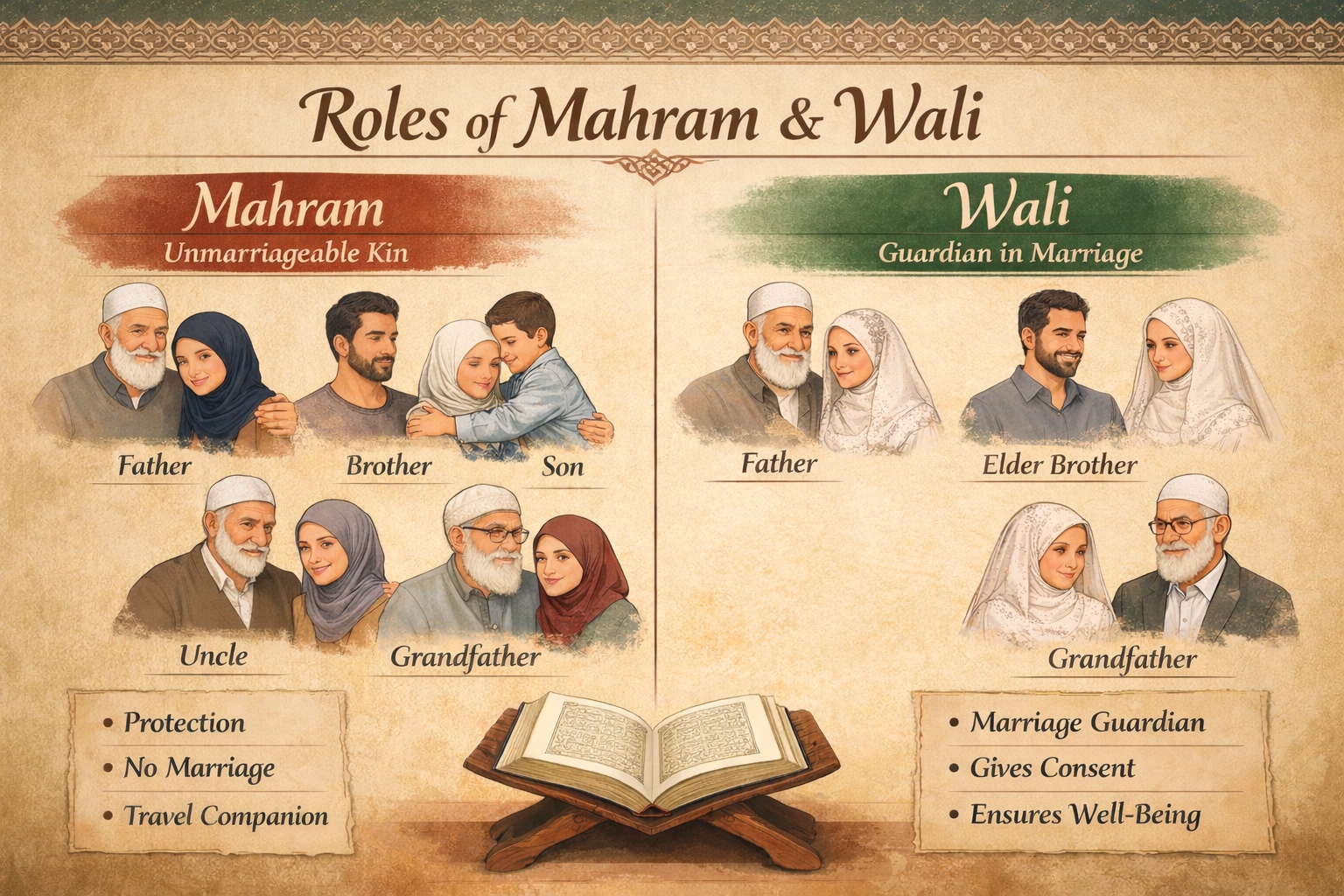
A mahram is a person you cannot marry due to close kinship, milk kinship (through breastfeeding), or marital ties. This includes parents, grandparents, children, siblings, uncles, aunts, nieces, nephews, and in-laws like a mother-in-law, once the marriage is finalised. It does not include cousins, who are not mahram in Islam. A mahram’s role is relational. It is about honour, protection, and boundaries. A mahram is someone you do not observe hijab in front of (with normal respect), and someone who cannot act in a romantic capacity with you.
Crucially, a mahram is not the same as a Wali. A mahram can be part of your safety net during courtship. He can accompany you to meetings, support you at events, and help you judge character. Yet the Wali’s role is legal and procedural. The Wali acts in the marriage process. The mahram promotes safety and dignity around it. In some families the same person may be both, such as a father. But the functions remain distinct.
From Support to Safety: What Mahrams Actually Do
In real life, mahrams bring calm and clarity. They help to keep meetings respectful and focused. A father, brother, or uncle can attend early conversations. He can help ask difficult questions with a gentle, protective tone. Because he knows you, he can also spot red flags and guide you away from pressure or manipulation.
Furthermore, mahrams are helpful beyond introductions. They can offer practical support in day-to-day logistics, such as travel for meetings, interacting with the other family, or safeguarding communications. They do not replace your insight or your consent. Instead, they help ensure that your dignity is not compromised and that you can make decisions in peace.
The Gate of Trust: Who Is the Wali and What Is His Duty?
The Wali is the guardian who represents and protects the bride’s best interests during the marriage process. In many cases, the father is the Wali. If the father is not present or not suitable, a grandfather, brother, or paternal uncle may step in, following the recognised order of guardianship in Islamic law. The Wali’s duty is to safeguard the bride’s rights, verify the groom’s character and commitment, and ensure that the contract terms are fair.
In the marriage ceremony (nikah), the Wali traditionally offers the bride in marriage and consents to the contract on her behalf, after the bride gives her own consent. This is more than a signature. It is a moral check and a communal pledge. The Wali’s involvement sends a message: this union has been approached with care and responsibility.
Consent at the Centre: No Nikah Without Willing Hearts
Islam protects consent. A woman cannot be forced into marriage. The Prophet Muhammad taught that a widow or divorced woman has the strongest say over herself, and a virgin must also be consulted and her permission sought. Silence can be a form of consent for the shy, but silence is never a tool for coercion.
Because consent is vital, the Wali’s role supports, not suppresses, the bride’s voice. He asks questions she might hesitate to raise. He checks the groom’s claims. He ensures that the mahr (the marriage gift to the bride) is fair and agreed. If concerns are serious, he can halt the process. He is not a gatekeeper against the bride. He is a gatekeeper for her.
School Differences: How Jurists View the Wali
Classical Islamic schools of law differ in how they handle the Wali for an adult woman. The majority of scholars (for example, in Shafi’i and Hanbali schools) require the Wali’s role for the validity of the marriage. The Hanafi school, however, allows an adult, sane woman to contract her own marriage without a Wali, provided the match is suitable and the terms are fair. Even in the Hanafi view, involving a Wali remains wise and encouraged, because it strengthens due diligence and community support.
Moreover, if a woman does not have a Muslim male Wali—for example, a new Muslim whose family is not Muslim—then an imam, judge, or recognised community leader can act as Wali. This ensures that no one is left without support. It keeps the process dignified and fair.
Beyond the Ceremony: The Wali’s Ongoing Care
The Wali’s role does not end at the nikah. He can continue to advise with tact and kindness. He may help mediate disagreements early, when they are small and easier to resolve. He can encourage the couple to seek knowledge, attend pre- and post-marital education, and learn their rights and duties.
However, the Wali must respect the couple’s privacy and autonomy. Marriage creates a new household. Healthy boundaries are essential. Good guardianship balances support with space, advice with trust. It exists to strengthen the marriage, not to control it.
Witnesses, Mahr, and the Contract: Placing Each Piece
It helps to see the whole picture. In a nikah:
- The bride gives consent.
- The Wali (according to the majority view) offers the bride in marriage and consents on her behalf.
- Two reliable witnesses hear the contract.
- The groom offers mahr to the bride. Mahr is not the same as a mahram. Mahr is a gift or dower to the bride; a mahram is a close relative who cannot marry her.
Each element has a purpose. Consent protects autonomy. The Wali protects welfare. Witnesses protect transparency. Mahr honours the bride. Together, they create a safe, public, and respected bond.
Meeting Well: How Guardianship Shapes Halal Courtship
In practice, guardianship guides how couples meet and get to know each other. The aim is to reduce harm and keep intention clear. Meetings can be purposeful, time-limited, and in appropriate settings. A mahram’s presence—either physically or via a sensible monitoring method—helps keep interactions focused and respectful.
At the same time, the couple should speak enough to understand values, life goals, financial expectations, and family roles. They should discuss faith practice, communication styles, and conflict resolution. A wise Wali encourages these conversations. He also supports educational steps before and after marriage to build skills for a peaceful home.
Boundaries and Balance: What Mahrams Are Not
It is important to avoid confusion. A mahram is not a micromanager of a woman’s life. He does not own her choices or override her mind. His role is to protect, not to police. Likewise, a mahram is not a replacement for the Wali within the contract. He may assist in introductions and safety, but the Wali carries the legal guardianship function.
Similarly, the term “guardian” never means taking away consent. Islam forbids forced marriage. Positive guardianship gives confidence to the couple and comfort to both families. It creates a shared culture of respect that carries into married life.
Digital Age, Timeless Wisdom: Safety with Modern Tools
Romance fraud and online deception have made modern matchmaking risky. Yet Islamic teachings already offer a safety net: clarity, consent, witnesses, and guardianship. When blended with technology, these principles become even stronger. For instance, identity verification removes anonymity that predators exploit. Transparent chaperoning features make conversations accountable. Consent-based sharing keeps control with the user.
MMS integrates these safeguards by design. Identity checks through Yoti build trust from the start. ProfileShield enables secure profile sharing with optional guardian approval, so your Wali can review key details before conversations go far. DynamIQ Guardian allows optional mahram monitoring, which discourages dishonest behaviour and ensures that interactions remain halal and respectful. This modern approach simply extends the spirit of guardianship into the online space.
Clear Guidance: Best Practices for Families
Here are practical tips in a clear format:
- Involve your Wali early. Let him know your intentions, non-negotiables, and concerns.
- Use trusted platforms with strong ID checks. Avoid private chats with strangers.
- Keep meetings purposeful and time-bound. Share goals and ask direct questions.
- Bring a mahram or use secure monitoring tools for extra safety and clarity.
- Seek marriage education before and after the nikah. Build skills, not just excitement.
For the Bride: Your Voice, Your Rights
- Share your expectations openly with your Wali. Be honest about timelines and preferences.
- Ask for a clear plan: how to meet, what to discuss, and how to check references.
- Confirm the mahr and contract terms in writing. Understand maintenance, housing, and financial duties.
- Never ignore red flags: secrecy, pressure, financial manipulation, or disrespect.
- Remember: your consent is essential. If you feel unsafe or unsure, pause and seek advice.
For the Groom: Leadership as Responsibility
- Approach the Wali with respect and clarity. Be honest about work, finances, and family.
- Honour the bride’s mahr and rights. Do not bargain in a way that undermines dignity.
- Embrace education: communication, conflict resolution, and Islamic duties.
- Welcome the presence of mahrams or monitoring features. They protect both of you.
- Show consistency. Reliability matters more than grand words.
For the Wali: Advocacy with Wisdom
- Listen first. Understand the bride’s values, hopes, and boundaries.
- Verify the groom’s character through references, community reputation, and conduct.
- Facilitate, do not frustrate. Support meetings that are safe and purposeful.
- Intervene only when needed. Protect the bride’s rights while respecting her judgement.
- Encourage the couple to seek ongoing learning and, if needed, counselling.
Common Misconceptions: Quick Clarifications
- “A mahram and the Wali are the same.” They are not. A mahram is a close relative; a Wali is the legal guardian for marriage.
- “Guardianship removes a woman’s voice.” It does not. Guardian involvement supports her voice and protects her interests.
- “Consent can be assumed.” It cannot. Consent is central and must be clear.
- “Cousins are mahram.” They are not. They can be potential spouses.
- “Mahr and mahram are related.” They are not. Mahr is the dower; mahram is an unmarriageable relative.
Bridging Cultures: Community Expectations and Real Needs
In many Western contexts, Muslims navigate professional life, diverse cultures, and digital spaces. Here, guardianship can feel unfamiliar or even awkward. Yet, when explained in a caring way, most people appreciate its purpose: protection, clarity, and respect. It gives families a role without taking away personal agency.
Moreover, guardianship can ease cultural pressure by making the process transparent. It moves conversations away from gossip and towards responsible decision-making. It also reduces unrealistic expectations by keeping discussions practical and values-led.
Special Cases: Reverts, Distance, and Sensitive Circumstances
For new Muslims without a Muslim family, a trusted imam or recognised community leader can act as Wali. This protects the new Muslim from isolation or manipulation. If families live far apart, guardianship can still function through video calls, verified profiles, and documented agreements.
Sensitive situations need tact. A Wali should be kind, patient, and focused on the bride’s welfare. If there is a history of harm, the community should help find an alternative Wali through proper channels. The goal is always the same: safety, fairness, and dignity.
Education Is Protection: Building Skills for a Lasting Marriage
Guardianship is not only about checking boxes. It is also about educating hearts. Pre-marital courses teach rights and responsibilities. They show how to communicate gently and how to resolve conflict without cruelty. Post-marital support keeps couples strong through life changes.
Platforms like MMS reinvest in education and community guidance. This makes the matchmaking process part of a wider ecosystem of learning. Healthy marriages then support healthy families, and healthy families strengthen the Ummah.
Financial Clarity: Mahr, Wedding Costs, and Realistic Plans
A thoughtful Wali helps the couple discuss finances early. This includes the mahr, day-to-day budgets, and wedding plans. A simple nikah is permissible and often wise. It places less stress on the couple and allows them to focus on building a life together.
For those who struggle with costs, community initiatives and ethical platforms may offer guidance or support funds. Making finances transparent reduces pressure, avoids disappointment, and fosters trust from the start.
Living the Sunnah: Mercy, Modesty, and Mutual Care
At its heart, guardianship reflects the Prophetic spirit of mercy. Modesty in meeting, honesty in discussion, and care in decision-making set the tone for marriage. Mahrams help maintain respectful boundaries. The Wali ensures fairness and clarity. Witnesses make the union public and honourable. And the couple, united by faith, step forward in trust.
When these roles are understood and embraced, they do not feel heavy. They feel like gentle guardrails—quiet supports that help love travel safely to its destination.
Safe by Design: How MMS Aligns Guardianship with Innovation
- Digital ID Verification (via Yoti): Confirms that the person behind the profile is real, reducing the risk of fraud or deception at the very first step.
- DynamIQ Guardian: Optional mahram monitoring that mirrors traditional chaperoning in a modern format, making interactions safer and more focused.
- ProfileShield: Controlled profile sharing with the option for guardian approval, so the Wali can review and advise before things move ahead.
- Education and Support: Pre- and post-marital coaching and courses via counselling partners that equip couples for real life.
- Community Care: A Marriage Fund and reinvestment into education and support initiatives that put values before profit.
These tools do not replace the role of families. They strengthen it. They make it easy to practise modesty, consent, and clarity in a digital age.
From First Conversation to Contract: A Simple Roadmap
- Set intention and involve your Wali early.
- Use a trusted platform with verified identities.
- Meet with dignity—bring a mahram or enable monitoring features.
- Ask value-based questions and share your life goals.
- Agree on mahr and practical plans in writing.
- Complete the nikah with consent, a Wali (as applicable), witnesses, and a clear contract.
- Continue learning together. Seek advice when needed and invest in your relationship.
Closing Reflections: Guardianship as a Gift
When we describe mahrams and Wali clearly, confusion fades. Far from restricting, guardianship actually frees couples to focus on what matters—character, faith, and compatibility. It lowers risks, builds trust, and roots love in responsibility. In the end, guardianship is a gift from our tradition to our times. It is a promise that the journey to marriage can be safe, dignified, and hopeful.