
The Illusion of Perfection: Unpacking the Clinical Approach to Matrimony
Your marriage search isn’t failing because you possess high standards. It is failing because you turned a profound human connection into a sterile spreadsheet. In today’s fast-paced digital era, many young Muslims attempt to “data-entry” their way into a successful marriage. We treat potential spouses like job applicants, demanding perfect resumes filled with exact heights, specific degrees, and flawless financial portfolios. Consequently, we reduce vibrant, complex individuals to mere statistics. You cannot build a lifelong partnership with a statistic, and you certainly cannot spreadsheet your way into love.
Currently, Muslim communities in the West face a growing marriage crisis. The rising divorce rates paint a sobering picture: 42% of British Muslim marriages end in divorce, and in North America, the rate exceeds 30%. Delayed marriages run rampant as individuals focus intensely on careers, succumb to cultural pressures, and struggle with limited halal networking options. In response to the fear of heartbreak and the overwhelming pressure from traditional matchmaking, many singles build an armor of checklists. We mistakenly believe that finding perfection will protect us from pain and divorce. However, this clinical tick-box exercise actively fails us. Instead of building a solid foundation rooted in Islamic principles, we chase a fantasy.
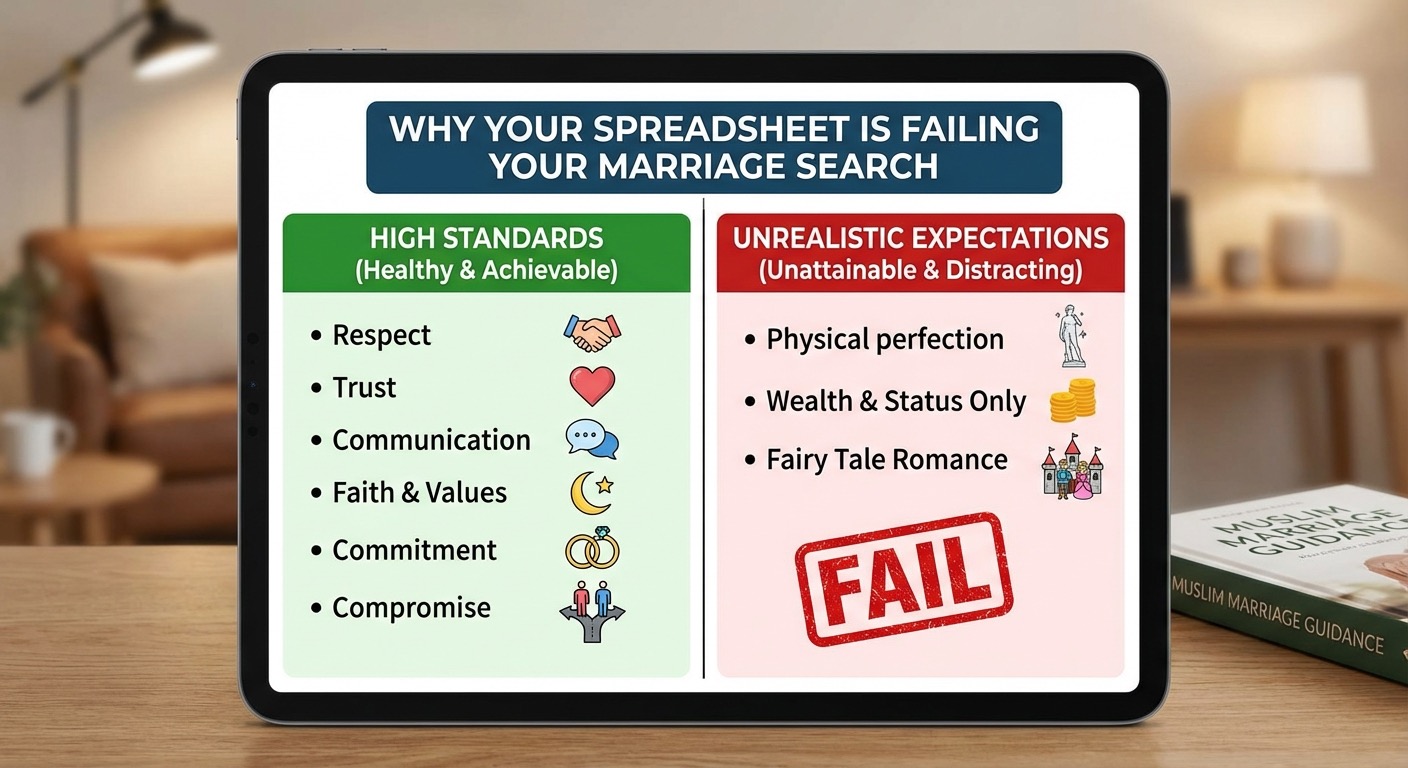
Understanding the crucial difference between high standards vs unrealistic expectations in Muslim marriage forms the first step toward resolving this crisis. Unrealistic expectations involve demanding a flawless partner who checks every superficial box—beauty, salary, or elite education. High standards, on the other hand, focus on character, emotional maturity, and Deen. Real standards involve requiring emotional safety, mutual accountability, and the capacity to repair mistakes. By recognizing this distinction, you can stop searching for the perfect CV and start looking for a genuine human connection.
Trading the Fairy Tale for a Teammate: Redefining the Modern “Soulmate”
Society constantly feeds us the fairy tale of the “soulmate.” Modern culture conditions you to expect someone who will instantly “complete” you or magically heal your past traumas. However, viewing a spouse through this lens turns them into a project rather than a partner. A soulmate, in the heavily romanticized Western sense, is a myth that breeds disappointment. When you expect another human being to carry the weight of your entire happiness and emotional healing, you set the marriage up for failure before it even begins.
Instead of hunting for a soulmate to stare at, you need a teammate you can build with. A teammate allows mutual growth. They do not carry your life; they actively add to it. A teammate steps up when the situation becomes difficult. Marriage does not represent the finish line; it constitutes the starting blocks of a profound journey together. While a romanticized soulmate might temporarily inspire you, a dedicated teammate helps you win the marathon of life. They do not abandon ship when the initial butterflies fade; they double down when the work gets hard.
When evaluating a potential teammate, you must ask different questions. Can they handle a “No” without erupting into anger? Do they take ownership of their mistakes? Do they respect your boundaries? These traits indicate a person who is ready to do the heavy lifting when life inevitably gets messy. Therefore, lower your expectations of absolute perfection, but never compromise or lower your standards for fundamental respect.
Navigating the Digital Minefield: Security, Fraud, and Restoring Trust
The modern path to marriage presents several unprecedented barriers, particularly in the digital realm. Romance fraud remains an evolving, serious threat. According to the City of London Police, romance scams cost UK victims over £106 million in 2024 alone. Many contemporary dating apps lack basic ID verification, leaving vulnerable users exposed to financial fraud, emotional manipulation, and profound psychological harm. When you combine unsafe online platforms with traditional matchmaking pressures, the search for a spouse becomes an exhausting, anxiety-inducing endeavor.
Muslim Marriage Services (MMS) directly tackles these modern challenges by prioritising absolute security and ethical innovation. As the world’s only Certified Social Enterprise Muslim marriage platform, MMS builds its foundation entirely on Islamic principles and trust. To combat the rampant threat of digital deception, MMS verifies every single member through a strategic biometrics partner, Yoti—a Certified B Corporation and global leader in robust AI identity solutions. This digital ID verification creates a secure environment where users can focus on meaningful connections rather than constantly questioning a profile’s authenticity.
Furthermore, MMS introduces advanced safety features designed specifically to restore trust and protect member dignity. The DynamIQ Guardian™ offers optional mahram monitoring, safeguarding users from deception, coercion, and predatory behavior. Additionally, ProfileShield™ enables secure profile sharing with optional guardian approval. These innovative features empower young Muslims (aged 18-30) by providing a transparent, halal environment where individuals retain total autonomy, choice, and control.
Beyond the Introduction: Education, Financial Support, and Strengthening the Ummah
Finding a compatible teammate represents only the beginning of the journey. Many couples enter marriage completely unprepared for the realities of domestic life. They lack crucial guidance on effective communication, healthy conflict resolution, and a deep understanding of Islamic rights and responsibilities. The absence of comprehensive marriage education directly fuels the rising divorce rates we see in Western Muslim communities today. Furthermore, severe financial barriers prevent many compatible couples from uniting. The rising costs of living, coupled with cultural expectations surrounding extravagant weddings, make even a modest Nikah feel completely out of reach for many young professionals and reverts.
MMS fundamentally changes this narrative because it operates as a movement, not just a matching app. By blending Islamic principles with modern technology, MMS goes far beyond mere introductions. The platform provides comprehensive education and support, offering pre- and post-marital courses, coaching, and counselling. Reinvesting in community support initiatives ensures that couples possess the practical tools necessary to nurture stronger marriages. Moreover, MMS actively reduces financial barriers through its Marriage Fund, which provides financial assistance for those unable to afford basic wedding costs, thereby strengthening the Ummah.
Guiding this transformative approach is the Muslim Marriage Services Guardian Council (MGC). Led by a respected female Shariah scholar and a global family solicitor with over 20 years of experience, the MGC ensures that all practices remain expert, balanced, and strictly Shariah-compliant. By centering women’s voices in its decision-making process, the Council reinforces inclusivity and sets exceptional standards in trust. Led by Hajji Mostafa, MMS offers a modern, trusted alternative to informal networks, completely removing the toxic financial incentives and cultural pressures that plague traditional matchmaking. Stop spreadsheeting your way through life. Start your journey toward a reliable teammate today at MuslimMarriage.global. Ameen.