

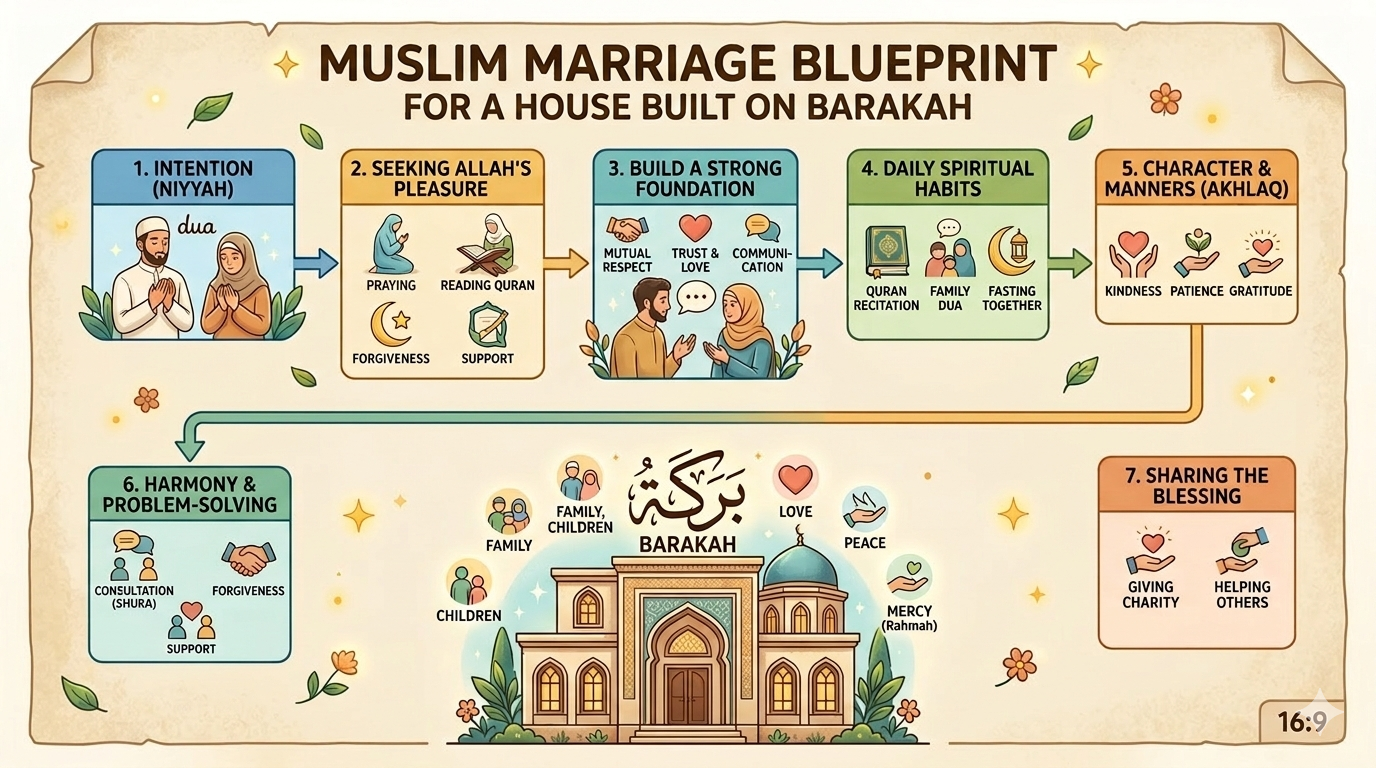
You have officially completed the Nikah. The Walimah lights have dimmed, the last of the guests have offered their Duas and headed home, and the celebratory noise has finally faded into a quiet, profound stillness. Now, it is just the two of you standing at the threshold of a shared life, perhaps looking at each other and wondering: “What now?”
While many people spend months—even years—planning the perfect wedding day, very few spend equivalent time planning the first ninety days of the marriage itself. However, these initial three months represent the most critical period of your relationship. They are not necessarily the most romantic or the easiest, but they are undeniably the most formative. During this window, you will establish the patterns, habits, and psychological dynamics that will define your household for decades to come. This period is your Muslim marriage blueprint, the foundation upon which your entire future rests.
Most couples unfortunately stumble through this transition by making it up as they go. They often learn through painful trial and error, inadvertently repeating the mistakes of previous generations or bringing unexamined cultural baggage into their new Islamic home. They miss the golden opportunity to build something intentional because no one provided them with a map. Fortunately, you are reading this guide with the intention to do things differently. By grounding your start in the Sunnah and modern ethical safety, you can transform the “adjustment period” into a launchpad for a lifetime of peace.
The Pre-Launch Strategy—Architecting the Foundation Before the Contract
The true 90-day journey does not actually begin on your wedding night; it begins in the final week leading up to the Nikah. Think of this as the “pre-construction” phase of your Muslim marriage blueprint. During this time, you must shift your mindset from being an independent individual to being part of a spiritual and social unit. This requires more than just picking out outfits; it requires deep, honest communication and spiritual alignment.
Firstly, you must prioritize consistent, shared Dua. Even if you are not yet living together, you should both be performing Salat al-Istikhara and asking Allah (SWT) to place Barakah in your union. Ask for a home that is a source of tranquility (Sakina) and a partnership that leads both of you closer to Jannah. This spiritual synchronisation ensures that your intentions are purified before the heavy responsibilities of marriage begin. When you start with the Creator, the creation falls into place more easily.
Secondly, use this final week to have the “Hard Conversations” that most people avoid. Sit down—with a Wali or via a supervised platform like Muslim Marriage Services (MMS)—and discuss the practicalities of life. These are not “unromantic” topics; rather, they are the bricks and mortar of a stable home. By resolving potential conflicts before they happen, you prevent months of assumptions and disappointment.
Key Topics for Your Pre-Launch Dialogue:
- Financial Stewardship: Will you maintain joint or separate accounts? Who is responsible for specific utility bills, and how will you manage Zakat and Sadaqah?
- Domestic Expectations: What are your views on gender roles versus practical contribution? How will chores like cooking, cleaning, and grocery shopping be divided?
- Family Boundaries: How often will you visit in-laws? How will you protect the privacy of your marital secrets from extended family members?
- Career and Ambition: How will you support each other’s professional growth while maintaining a healthy home-life balance?
- Conflict Styles: How do you typically react when angry or stressed? What can your partner do to help you de-escalate?
Furthermore, mental preparation for the inevitable adjustment is vital. You are moving from a world of “I” to a world of “We.” This transition involves a loss of total independence and a gain of beautiful interdependence. It is normal to feel a mix of excitement and nervous tension. For the husband, this means preparing a home that is welcoming and clean, showing his wife that her comfort is his priority. For the wife, it involves lowering the pressure of “perfection” and allowing herself the grace to grow into her new role alongside her partner.
Month One—Constructing the Spiritual and Practical Infrastructure
The first thirty days of your marriage are about setting the “default settings” of your relationship. Just as a new computer needs its operating system installed correctly, your marriage needs a functional routine. This month is dedicated to establishing daily rhythms that honor both your Islamic obligations and your emotional needs. This is the stage where the Muslim marriage blueprint starts to take a physical and spiritual form.
During the first week, often called the honeymoon phase, your primary focus should be spiritual habit-stacking. Start your very first night with two Raka’at of prayer together. This act signals to each other—and to Allah—that your marriage belongs to Him first. From that point forward, make it a non-negotiable rule to pray Fajr together whenever possible. When a couple wakes up for the sake of Allah before the sun rises, they invite a unique light into their home that protects them from the whispers of Shaitan throughout the day. Additionally, spend fifteen minutes daily reciting the Qur’an together. These small, consistent acts create a spiritual shield around your new union.
Practically speaking, the first month is also when you must navigate the “choreography” of living together. You will discover each other’s daily habits—how the other likes their coffee, how they fold laundry, or how much phone usage they prefer in the bedroom. Do not leave these things to chance. Discuss them openly. If the husband leaves towels on the floor or the wife takes longer to get ready than expected, handle these discoveries with humor and patience rather than criticism.
Establishing Your Daily Harmony:
- The “Roses and Thorns” Ritual: Every evening, share one thing you appreciated (the rose) and one thing that was challenging (the thorn). This builds a habit of daily emotional check-ins.
- The No-Phone Zone: Designate specific times, such as dinner or the hour before bed, as tech-free to encourage genuine conversation.
- Shared Responsibility: Don’t wait to be asked. If you see a task that needs doing, do it for the sake of Allah to ease the burden on your spouse.
As you enter the second week, reality typically begins to set in. The initial adrenaline of the wedding fades, and the first disagreement usually arises. This is a pivotal moment in your Muslim marriage blueprint. Instead of reacting with anger, follow the Prophetic model of conflict resolution. Pause, make Wudu to cool your temper, and pray two Raka’at. When you finally speak, use “I feel” statements instead of “You always” accusations. For example, say, “I feel overwhelmed when the kitchen is messy,” rather than, “You never clean up.” Resolving your first argument with Adab (manners) sets a precedent for every argument you will have for the next fifty years.
Month Two—Deepening the Emotional Reservoir and Social Bonds
By the second month, the “newness” has worn off, and you are beginning to find your rhythm. Now is the time to go deeper. If month one was about building the walls, month two is about the interior design—the emotional and psychological intimacy that makes a house a home. This is the period where you move beyond surface-level conversations and start exploring the “why” behind your spouse’s actions.
One of the most effective ways to deepen your bond is through shared spiritual growth. Beyond the mandatory prayers, try to pray Tahajjud together at least once a week. There is a profound intimacy in standing together in the middle of the night, whispering Duas while the rest of the world sleeps. This practice humbles both spouses and reminds you that you are travelers on the same path toward the Hereafter. Moreover, choose an Islamic topic to study together—perhaps the Seerah of the Prophet (PBUH) or a book on Islamic character. Learning together ensures that you are growing at the same pace intellectually and spiritually.
In addition to spiritual depth, you must address the social dimension of your marriage: the families. By month two, the pressure from in-laws and extended relatives often begins to mount. It is essential to present a united front. While Islam emphasizes the utmost respect for parents, your primary responsibility now is to protect the sanctity and privacy of your marriage.
Managing Social and Emotional Dynamics:
- The United Front: Never complain about your spouse to your own parents. Resolve issues internally to maintain the respect between your spouse and your family.
- The Language of Love: Identify your spouse’s love language (Words of Affirmation, Acts of Service, Receiving Gifts, Quality Time, or Physical Touch).
- Scheduled Solitude: Ensure you have “blackout dates” where it is just the two of you, free from the obligations of visiting extended family.
Furthermore, focus on the Prophetic model of affection. The Prophet (PBUH) was never shy about showing love; he would race with Aisha (RA) and drink from the same spot on the cup as her. Emulating this playfulness and gentleness ensures that your marriage remains a source of joy rather than just a list of duties. When you intentionally “speak” your spouse’s love language every day, you reinforce the Muslim marriage blueprint with layers of emotional security.
Month Three—Solidifying the Long-Term Visionary Horizon
As you approach the 90-day mark, you are no longer “newlyweds” in the sense of being strangers to the routine. You have survived the first few disagreements, you have settled into your home, and you understand each other’s quirks. Now, it is time to look at the horizon. Month three is about shifting from “survival mode” to “visionary mode.”
Sit down together and create a “Marriage Constitution” or a long-term vision board. This is a vital component of the Muslim marriage blueprint. Ask each other: Where do we want to be in five years? How many children do we hope to have, and what values do we want to instill in them? What are our financial goals, such as saving for Hajj or a first home? Writing these goals down transforms your marriage from a day-to-day existence into a mission-driven partnership. When you both know what you are working toward, daily stresses become much easier to manage because they are seen as small steps toward a much larger, beautiful goal.
Additionally, use this time to master the art of gratitude. By day sixty or seventy, it is very easy to start taking each other for granted. The “thank yous” might become less frequent, and the compliments might start to dry up. Combat this by implementing a daily gratitude practice. Tell your spouse one specific thing they did that day that made your life better. Gratitude is a powerful antidote to Shaitan’s attempts to make you focus on your spouse’s flaws. When you focus on what is going right, Allah (SWT) promises to increase your blessings.
Finalising the Blueprint for the Future:
- Review Conflict Resolution: Are there lingering issues? If so, seek help through MMS coaching or counseling.
- Financial Audit: Review your spending from the first 60 days. Are you staying within your means?
- Educational Commitment: Sign up for a post-marital course to continue learning about Islamic rights and responsibilities.
Finally, remember that a strong marriage is not one that never has problems; it is one that has the tools to fix them. By the end of these 90 days, you should feel like a cohesive team, ready to face the world with Allah as your witness and the Sunnah as your guide.
The Pillars of Safety and Growth—A Commitment to Excellence
Building a marriage in the modern age requires more than just good intentions; it requires a commitment to safety, ethics, and continuous learning. In a world where digital threats and “romance fraud” are on the rise, grounding your relationship in a secure environment is paramount. This is why platforms like Muslim Marriage Services (MMS) are so revolutionary. By verifying every member through biometric technology like Yoti and offering features like DynamIQ Guardian™ for mahram monitoring, MMS ensures that the “pre-90-day” phase is built on a foundation of absolute trust and transparency.
If you are currently in the process of seeking a partner, remember that the Muslim marriage blueprint works best when both partners are starting from the same page of integrity. You want someone who values Shariah compliance as much as you do—someone who isn’t just looking for a wedding, but is prepared for the work of a marriage. As a Certified Social Enterprise, MMS reinvests in the Ummah by providing marriage funds for those in financial need and offering pre-marital education to ensure that couples don’t enter the “first 90 days” blindfolded.
Ultimately, your marriage is an Ibadah (act of worship). Every time you smile at your partner, every time you hold back a harsh word, and every time you encourage them to pray, you are earning rewards from Allah (SWT). The first 90 days are your training ground. If you build this foundation with care, patience, and Taqwa, you aren’t just building a home for this life—you are building a palace for the next. May Allah (SWT) bless your union, grant you righteous offspring, and make your home a beacon of light for the entire Ummah. Ameen.