

Marriage (Nikah) is one of the most sacred, honoured, and beautiful institutions established by Allah (SWT). Designed to be a source of love, mercy, tranquility, and mutual respect (Mawaddah wa Rahmah), it forms the bedrock of a healthy Muslim family and society.
However, cultural customs often obscure the radiant clarity of Islamic teachings. One of the most prevalent and damaging misconceptions—both within Muslim communities and in Western societies—is the conflation of arranged marriages with forced marriages. While they are frequently spoken of in the same breath, they exist on entirely opposite ends of the moral, legal, and spiritual spectrum.
Understanding the line where family involvement crosses into coercion is not just an academic exercise; it is an obligation to preserve the rights, dignity, and spiritual well-being of Muslim men and women.
1. Defining the Core Difference: Consent vs. Coercion
To understand the difference, it helps to view the comparison through a simple framework: Agency.
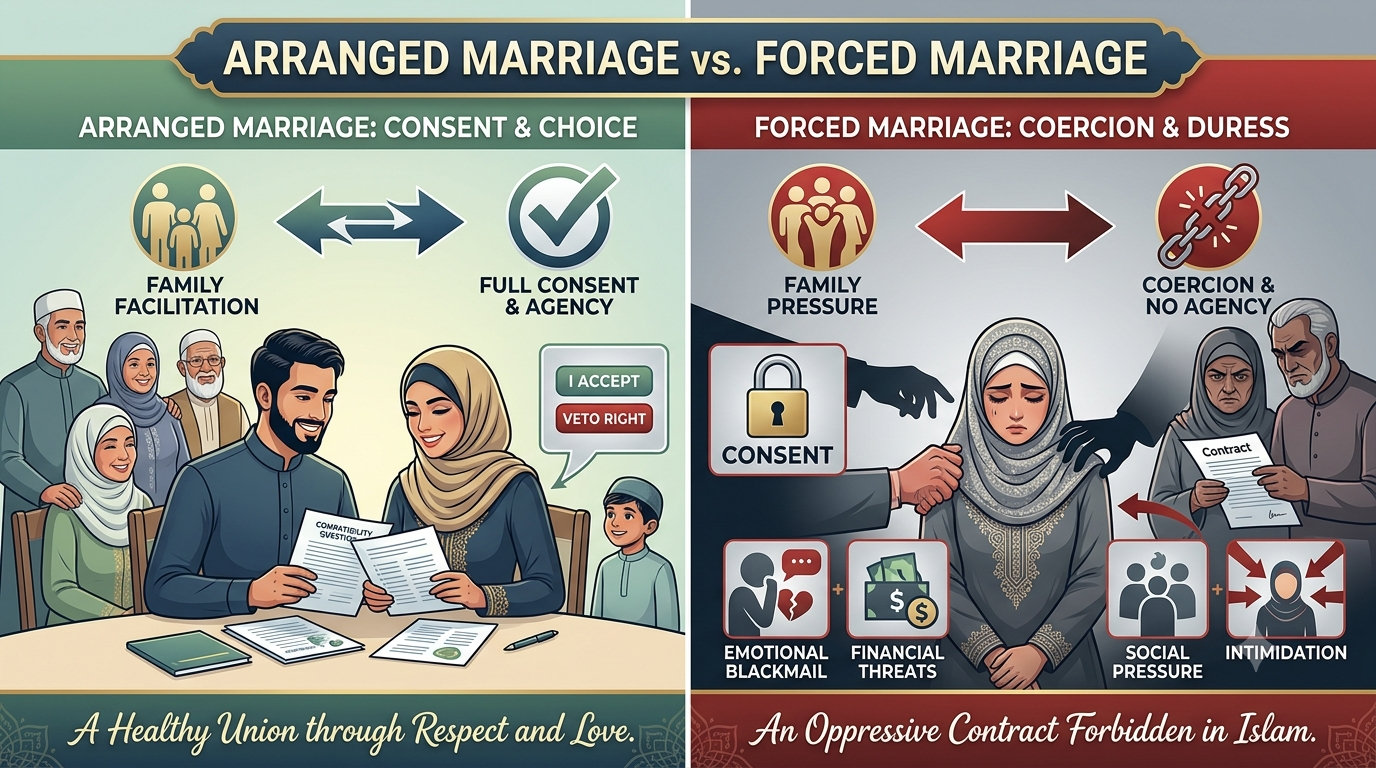
- Arranged Marriage: A collaborative process where families take the lead in identifying, vetting, and introducing potential partners based on shared values, compatibility, and background. Critically, the ultimate decision and power of veto rest entirely with the prospective bride and groom. Both individuals maintain full agency from introduction to the Nikah.
- Forced Marriage: A situation where one or both parties are married without their full and free consent, or where consent is extracted under duress. In a forced marriage, personal agency is completely stripped away, and the union is entered into out of fear, obligation, or severe pressure.
Quick Reference: Arranged vs. Forced Marriage
| Feature | Arranged Marriage | Forced Marriage |
|---|---|---|
| The Power of Veto | Yes. Either party can say "no" at any stage without penalty. | No. Saying "no" leads to punishment, guilt, or isolation. |
| Ultimate Authority | The prospective bride and groom | The parents or extended family |
| Primary Driver | Parental guidance & mutual collaboration | Control, family obligation, or tribal alliance |
| Islamic Validity | Fully permissible and encouraged when done respectfully. | Strictly Haram (prohibited); the contract is invalid (Batil). |
| Legal Status (UK/West) | Completely legal and respected as a cultural practice. | A serious criminal offense and violation of human rights. |
| Emotional Tone | Excitement, mutual respect, and peace of mind. | Fear, anxiety, dread, and deep resentment. |
2. Anatomy of Coercion: The Five Types of Pressure
Many people mistakenly believe a forced marriage only occurs if someone is physically dragged to an altar or threatened at gunpoint. In reality, coercion is often far more subtle, insidious, and psychological. Under both modern human rights standards and Islamic jurisprudence, “consent” obtained through any of the following pressures is considered completely invalid:
A. Emotional Threats & Blackmail
This is perhaps the most common form of pressure used within families. It exploits the victim’s love and respect for their parents. Examples include:
- Threatening self-harm or suicide if the child does not agree (“You will give your father a heart attack if you say no”).
- Falsely claiming that a refusal will cause a parent severe illness, unmanageable grief, or spiritual ruin.
B. Family Coercion & Guilt
Family coercion weaponizes family dynamics to make the individual feel like an outcast or a failure.
- Constant, suffocating lectures from multiple extended family members (uncles, aunts, grandparents) leaving the individual with no mental safe space.
- Inducing extreme guilt by framing the marriage as a mandatory “debt” the child owes the parents for raising them.
C. Physical Intimidation and Violence
When psychological tactics fail, families may resort to overt or implied physical force.
- Actual physical assault, domestic abuse, or being locked in a room/house.
- Threatening to strand the individual in an unfamiliar foreign country or confiscate their passport, phone, and legal documents.
D. Social Pressure and Identity Weaponization
This involves leveraging the wider community or cultural concepts of “honor” (Ghayrah or Izzat) to crush an individual’s resolve.
- Telling the victim they will permanently ruin the family’s social standing, reputation, or business prospects in the community.
- Threatening social ostracization—warning the individual that if they refuse, no one in the community will ever speak to them or their siblings again.
E. Financial Threats
Economic dependence is frequently weaponized to force compliance, especially against young adults or students.
- Threatening to cut off university tuition, rent, or basic living expenses.
- Threats of complete financial dispossession, being written out of a will, or being kicked out of the family home with no financial safety net.
3. The Islamic Stance on Forced Marriage: It is Strictly Haram (Prohibited)
From a theological standpoint, there is absolutely zero ambiguity: Islam strictly prohibits forced marriage. For a Nikah to be valid, both parties must enter into it willingly. Consent is not a mere formality; it is a foundational pillar (Arkan) of the Islamic marriage contract.
Without explicit Ijab (proposal) and Qubool (acceptance) from both individuals, a marriage is considered fundamentally invalid (Batil). In the eyes of Islamic law, living in a forced marriage is not an act of religious obedience; rather, it constitutes an ongoing, unlawful arrangement.
Evidence from the Qur’an
Allah (SWT) explicitly defends the autonomy of women in the Qur’an:
“O you who have believed, it is not lawful for you to inherit women by compulsion…” (Surah An-Nisa, 4:19)
Evidence from the Prophetic Sunnah
The Prophet Muhammad (PBUH) consistently dismantled the pre-Islamic cultural practices that treated women as property to be bartered by their families.
- The Right of Refusal for Virgins and Matrons: Abu Hurayrah reported that the Prophet (PBUH) said:“A matron (divorced/widowed woman) should not be given in marriage except after consulting her; and a virgin should not be given in marriage except after her permission.” (Sahih al-Bukhari)
- The Precedent of Annulment: A classic historical event explicitly cements a woman’s right to veto. A young virgin woman came to the Prophet (PBUH) and mentioned that her father had married her to his nephew against her will to elevate his own social standing. The Prophet (PBUH) immediately gave her the full choice to either dissolve the marriage or keep it. Upon hearing this, the young woman said:“I have accepted what my father did, but I wanted to prove to women that fathers have no right to force them into marriage.” (Sunnan An-Nasa’i)
Shaykh al-Islam Ibn Taymiyyah summarized this beautifully by noting that a guardian has no right to force a person to live with or sleep with someone they find off-putting, just as they cannot force them to eat food they find repulsive.
4. The Beauty of a True Islamic Arranged Marriage
When practiced according to the Sunnah, an arranged marriage is highly effective and beautiful. Because Muslims generally do not engage in casual dating, an arranged marriage provides a safe, dignified, and structured framework to find a spouse.
How a Healthy Arranged Marriage Operates:
- Family Support: Parents and elders utilize their life experience, networks, and wisdom to filter candidates who share the same religious values, financial expectations, and long-term goals.
- The Halal Courtship: The couple is given ample opportunity to speak, ask critical questions about the future, and interact in a safe environment (with a Mahram or in appropriate settings) to gauge intellectual and emotional compatibility.
- The Power of Veto: If either the man or woman feels there is no spark or compatibility, they simply say “no.” The family respects this choice, makes du’a for them, and continues the search without resentment.
5. The Root Causes: Why Does Culture Trump Religion?
If Islam is so explicitly clear, why do forced marriages still happen in Muslim societies? The answer lies in the deeply entrenched grip of toxic cultural traditions over religious compliance.
- The Illusion of “Family Honor”: In many patriarchal cultures, a daughter’s obedience is tied directly to the public prestige of the family. Refusing a match is falsely viewed as a rebellion against the family name.
- Financial and Tribal Alliances: Marriages are sometimes used to keep wealth within a specific lineage, secure property, or strengthen tribal ties back home, ignoring the emotional cost to the individuals involved.
- Misguided Parental Obedience (Birr al-Walidayn): Children are frequently gaslit into believing that defying their parents’ choice of spouse constitutes the grave sin of parental disobedience. However, Islamic jurisprudence dictates that parents cannot demand obedience in matters that infringe upon your fundamental Islamic rights. Choosing a life partner is one of those rights.
6. The Reality in Numbers: A Modern Look at the Data
To understand that forced marriage is not a relic of history but an active, ongoing crisis, we only need to look at official statistics. The UK Government’s Forced Marriage Unit (FMU)—a joint initiative by the Home Office and the Foreign Office—publishes annual data that shatters several common myths about who is affected by this issue.
According to FMU data, the unit handled 1,295 total contacts regarding forced marriage and FGM, resulting in 406 high-risk, active cases requiring direct casework and intervention—a staggering 69% increase over previous annual baselines.
The data reveals three vital insights that every community member must understand:
A. It Affects the Extremely Young
Forced marriage is a direct threat to children. 40% of all cases handled by the FMU involved minors aged 17 and under, with over 20% of victims being 15 or younger. These are children who are legally and emotionally incapable of providing informed consent.
B. Men Are Victims Too
While women bear the disproportionate brunt of this practice (74% of cases), forced marriage is not exclusively a female issue. 26% of the FMU’s cases involved male victims. Young men are frequently subjected to intense familial pressure, financial manipulation, and emotional blackmail to enter unions against their will.
C. It Happens Right Next Door
A common misconception is that forced marriage only happens when a youth is sent “back home” to an overseas country (such as Pakistan, Bangladesh, or Afghanistan, which remain the top focus countries for the FMU). However, the data shows that 14% of cases had no overseas element at all. The coercion, preparation, and marriages were intended to take place entirely within Western borders.
Furthermore, 18% of cases involved individuals with mental capacity concerns (such as learning disabilities), making the unions entirely illegal under both secular and Islamic laws, as consent is impossible to give.
The Tip of the Iceberg: Human rights organizations like Karma Nirvana emphasize that the FMU’s numbers only reflect those who found a way to reach out for help. Because of intense family secrecy and fear of retaliation, the actual number of individuals suffering in silence is estimated to be far higher.
7. Psychological and Generational Impacts
Forced marriages do not just produce invalid contracts; they produce deep human suffering. The psychological toll on someone forced into a union includes:
- Severe Depression and Anxiety: Living intimately with someone you did not choose and do not desire creates a persistent state of emotional trauma.
- High Risk of Domestic Abuse: When a marriage begins with a violation of consent, it establishes a power dynamic ripe for further physical, emotional, or financial abuse.
- Generational Trauma: Children born into a home devoid of genuine love, mercy, and mutual consent grow up witnessing a broken model of marriage, continuing a cycle of dysfunctional family dynamics.
Conclusion: Reclaiming the Sunnah
An arranged marriage is an expression of family love, guidance, and community support. A forced marriage is an act of oppression (Zulm).
As a community, it is our collective duty to dispel these cultural myths. Parents must trust the upbringing they gave their children and respect their autonomy. Young Muslims must be empowered with knowledge of their Islamic rights so they can confidently differentiate between a family’s loving recommendation and a coercive demand.
True marital bliss begins the way Islam intended: with two hearts willingly, peacefully, and joyfully choosing to walk the path to Allah together.
Join the Founding 200 on MuslimMarriage.global
Finding a life partner should never mean compromising on your values, your safety, or your freedom of choice. We are building a secure, respectful global network designed for intentional Muslims who are serious about Nikah.
We are currently opening registration exclusively to our first 200 founding members. By joining this initial group, you will help us establish a community built on mutual respect and genuine intentions from day one.
For further information, visit: