

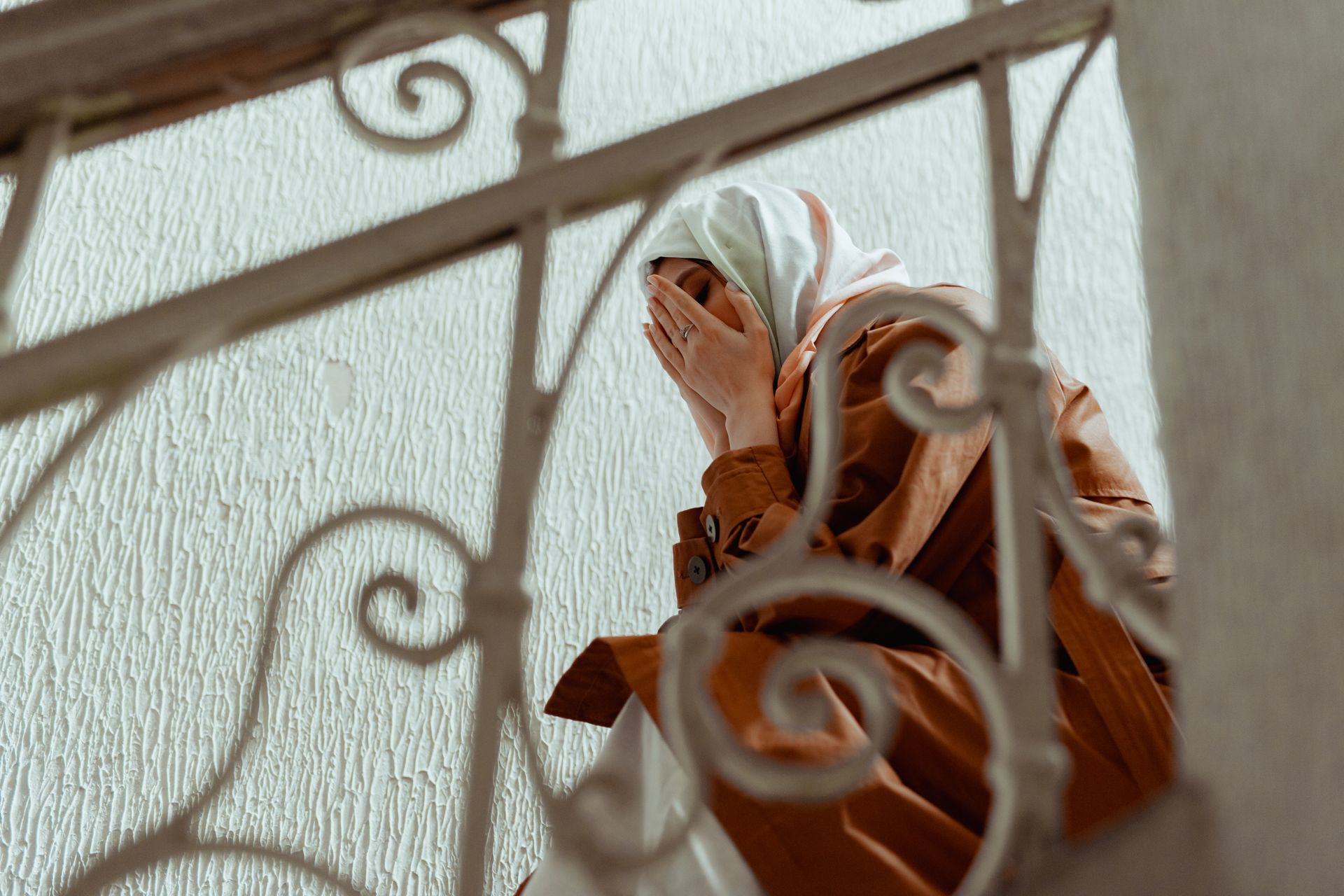
Marriage in Islam is meant to be a source of tranquillity, mercy, companionship and protection.
But what happens when the person who was supposed to provide safety becomes the source of fear?
What happens when a marriage that looked respectable from the outside becomes controlling, humiliating, frightening or violent behind closed doors?
And perhaps most painfully:
What happens when everyone around you tells you to be patient — but staying is destroying you?
If you are experiencing abuse within your marriage, this article is for you.
You do not need to minimise what is happening because you are married.
You do not need to remain in danger simply because you once made a commitment.
And you should never be made to believe that seeking safety, protection or separation makes you a bad Muslim.
At Muslim Marriage Services (MMS), we believe marriage should be built on trust, dignity, responsibility and safety.
Our vision is not simply to help Muslims get married.
It is to help create healthier marriages — and to recognise when something has gone seriously wrong.
Abuse Is Not Only Physical
One of the biggest misconceptions about abusive marriages is that abuse must involve physical violence.
It does not.
Domestic abuse can include controlling behaviour, emotional abuse, financial control, sexual abuse, threats, intimidation, coercive control and technology-based monitoring. UK government guidance explicitly recognises that abuse is not always physical. (GOV.UK)
An abusive spouse might:
- constantly insult or humiliate you;
- threaten you, your children or your family;
- control your access to money;
- prevent you from working or studying;
- isolate you from friends and relatives;
- monitor your phone, messages or social media;
- demand access to your passwords;
- control where you go and who you see;
- repeatedly accuse you of infidelity;
- pressure or force you into sexual activity;
- use religion to manipulate or frighten you;
- threaten divorce, abandonment or exposure to control you;
- damage property to intimidate you;
- physically assault you;
- threaten to harm themselves if you leave;
- repeatedly tell you that everything is your fault.
Some forms of abuse are obvious.
Others develop so gradually that the victim may not recognise what is happening until years have passed.
That is one of the reasons abusive relationships can be so difficult to leave.
“But They’re Not Always Like This…”
One of the most confusing aspects of an abusive marriage can be the good periods.
Perhaps your spouse becomes extremely apologetic after an incident.
Perhaps they promise that they will change.
Perhaps they cry.
Perhaps they become affectionate.
Perhaps they promise to seek counselling.
Perhaps they tell you:
“It will never happen again.”
And sometimes there genuinely are periods when everything appears normal.
That can make you question yourself.
You may think:
Maybe I exaggerated.
Maybe I provoked them.
Maybe I should have handled the situation differently.
Maybe marriage is supposed to be difficult.
Maybe I should just be more patient.
But a temporary period of kindness does not erase a pattern of abuse.
Nor should you have to live in fear of when the next incident will happen.
An apology is not the same thing as accountability.
A promise is not the same thing as sustained behavioural change.
And religious language should never be used as a shield against accountability.
Islam Does Not Give Anyone Permission to Abuse Their Spouse
This point deserves to be stated clearly.
Abuse is not justified by Islam.
Marriage does not give one spouse ownership over another.
Being a husband does not give a man permission to terrorise his wife.
Being a wife does not give a woman permission to humiliate, manipulate or harm her husband.
Neither spouse has the right to destroy the dignity of the other.
Islam places enormous importance on good character, mercy, justice and responsible treatment of others.
The Prophetic model of marriage was not built around intimidation.
It was built around mercy and excellent conduct.
Therefore, phrases such as:
“You have to obey your husband.”
“A good wife doesn’t leave.”
“A good Muslim woman keeps her marriage together at all costs.”
“Sabr means you have to tolerate it.”
should never be used to trap someone inside an abusive environment.
Sabr does not mean volunteering yourself for harm.
Patience does not mean accepting oppression indefinitely.
Seeking protection is not a failure of faith.
You Are Allowed to Take What Is Happening Seriously
Many victims spend years trying to determine whether their situation is “bad enough”.
They compare themselves with people experiencing more severe violence and conclude:
At least I’m not being beaten.
But abuse does not have to reach the most extreme level before you are allowed to seek help.
If you are frightened of your spouse, constantly walking on eggshells, being controlled, isolated, threatened, financially trapped or repeatedly degraded, those experiences matter.
You do not need to wait until the situation becomes catastrophic before taking action.
In fact, early recognition can be incredibly important.
Leaving an Abusive Marriage Requires Safety — Not Just Courage
One of the biggest mistakes people can make is assuming that leaving is simply a matter of saying:
“I’m done. I’m leaving.”
For some people, it may be possible to leave quickly.
For others, leaving can increase risk.
That is why an exit from an abusive marriage should be approached as a safety issue, not simply an emotional decision.
If your spouse is controlling or violent, consider speaking privately with a specialist domestic-abuse organisation, solicitor or other appropriately trained professional before announcing that you intend to leave.
You do not have to tell your abuser everything you are planning.
You do not have to confront them simply because you feel morally obligated to explain yourself.
Your immediate priority is safety.
Step 1: Recognise What Is Happening
Start by being honest with yourself.
Ask:
Do I feel safe in my own home?
Can I disagree with my spouse without being frightened of the consequences?
Am I free to see my family and friends?
Can I access my own money?
Can I make ordinary decisions without fear?
Does my spouse monitor my phone or communications?
Am I regularly insulted, humiliated or threatened?
Have I changed my behaviour because I am afraid of their reaction?
Have I started believing that everything is somehow my fault?
If the answers concern you, do not dismiss them.
Step 2: Tell Someone You Trust
Abuse thrives in isolation.
That does not necessarily mean telling everyone.
It may mean telling one safe person.
A trusted sibling.
A parent.
A close friend.
A professional.
A qualified counsellor.
A domestic-abuse adviser.
Someone who can listen without immediately judging you or pressuring you into a decision.
If you are Muslim, you may also want to speak with a trusted scholar or Islamic counsellor who understands domestic abuse and does not automatically treat preserving the marriage as the only acceptable outcome.
The wrong adviser can unintentionally make an unsafe situation worse.
For example, telling someone experiencing serious abuse simply to:
“Go home and be patient.”
may leave them more isolated.
Good support should begin with safety.
Step 3: Build a Safety Plan
A safety plan is not about assuming the worst.
It is about preparing for the possibility that you may need to act quickly.
Depending on your circumstances, this might include thinking about:
- where you could go;
- who you could contact;
- how you could travel safely;
- where important documents are kept;
- how you could access money;
- what medication you may need;
- what your children would need;
- who could help you;
- where you could stay temporarily;
- what you would do if your spouse became violent;
- how you could contact emergency services.
If your phone or internet activity may be monitored, be careful about how you research or store information.
The UK government specifically advises people to consider whether their devices are being monitored before downloading domestic-abuse support tools. (GOV.UK)
Do not put yourself at greater risk simply because you are trying to create a safety plan.
Step 4: Secure Important Documents
If it is safe to do so, consider making sure you can access important documents such as:
- passport;
- driving licence;
- birth certificate;
- marriage certificate;
- immigration documents;
- financial information;
- bank details;
- medication information;
- children’s documentation;
- important legal correspondence.
If keeping physical copies would put you at risk, speak to a specialist adviser about safer alternatives.
You do not need to resolve everything immediately.
The objective is simply to reduce the number of things that could prevent you from leaving safely if circumstances suddenly change.
Step 5: Think About Your Finances
Financial control can be a powerful method of trapping someone inside a relationship.
You may have no independent access to money.
Your spouse may control the bank account.
You may be prevented from working.
You may be given an allowance.
You may be threatened with homelessness if you leave.
These are not minor relationship disagreements.
UK government guidance recognises financial and economic control as forms of domestic abuse, and evidence of financial abuse can also be relevant when seeking legal aid. (GOV.UK)
If it is safe and appropriate, obtain professional advice about your financial position and your legal rights.
Do not make financial decisions that could put you or your children at greater risk without proper advice.
Step 6: Consider Your Children
Children can be profoundly affected by domestic abuse even when they are not physically assaulted themselves.
They may hear arguments.
They may witness intimidation.
They may see one parent frightened.
They may learn that controlling behaviour is “normal”.
They may become responsible for protecting a parent.
If children are involved, safety planning becomes even more important.
Do not assume that leaving an abusive relationship means you are destroying your children’s family.
Sometimes the opposite is true.
Children need an environment where they can experience security, stability and healthy relationships.
If children are involved, obtain appropriate specialist legal and safeguarding advice before making significant decisions about residence, contact or relocation.
Step 7: Get Legal Advice
Leaving a marriage can involve complicated questions about:
- divorce;
- housing;
- finances;
- children;
- immigration;
- protective orders;
- property;
- maintenance;
- evidence of abuse.
Do not rely solely on social media advice or well-meaning relatives.
Get advice from an appropriately qualified professional.
In England and Wales, people affected by domestic abuse may be eligible for legal aid depending on their circumstances and evidence requirements. GOV.UK explains the available routes and eligibility criteria. (GOV.UK)
There are also legal protections that may be available to victims, including protective court orders in appropriate circumstances. (GOV.UK)
Your legal position will depend on your individual circumstances, so professional advice matters.
Step 8: Understand That Leaving May Not Be One Single Event
Sometimes people imagine leaving as one dramatic moment.
But real life is often different.
You might emotionally leave before you physically leave.
You might spend weeks planning.
You might temporarily stay with family.
You might seek legal advice first.
You might leave and later return because circumstances become complicated.
You might need several attempts before you can establish a genuinely safe separation.
None of that means you have failed.
Leaving an abusive relationship can be complicated precisely because abuse is about power and control.
The important thing is to keep moving towards safety.
What About Family Pressure?
This can be particularly difficult within some Muslim families.
You may hear:
“What will people say?”
“Think about the family.”
“You have children.”
“Every marriage has problems.”
“Don’t bring shame on us.”
“Try one more time.”
Sometimes relatives genuinely believe they are helping.
But protecting the family’s reputation cannot come before protecting a human being from abuse.
A marriage certificate is not more important than someone’s safety.
Community reputation is not more important than someone’s dignity.
And avoiding gossip is not a legitimate reason to leave someone trapped in fear.
If your family does not understand the situation, seek support from people who do.
What About Counselling?
Counselling can be valuable in many marriages.
But there is an important distinction.
Relationship problems and abuse are not the same thing.
If one person is deliberately controlling or abusing the other, simply placing both people in a room and asking them to communicate better may not address the underlying power imbalance.
In some circumstances, joint counselling can even create additional risks if information disclosed in the session is later used against the victim.
That is why specialist advice should come first where abuse is suspected.
The question is not simply:
“How do we communicate better?”
It may be:
“How do we keep this person safe?”
What If They Promise to Change?
People can change.
But genuine change should involve more than apologies.
Look for sustained accountability rather than emotional promises.
That means recognising the behaviour, accepting responsibility, stopping the excuses and demonstrating meaningful change over time.
Statements such as:
“You made me do it.”
“You know what you’re like.”
“I only did it because I love you.”
“You pushed me too far.”
are not accountability.
Abuse is not transformed into love simply because the abuser says they are acting out of love.
What If I Still Love Them?
This is one of the hardest questions.
You can love someone and still recognise that the relationship is unsafe.
You can miss someone and still leave.
You can remember the beautiful moments and still acknowledge the terrible ones.
You can pray for someone and still establish boundaries.
You can forgive someone without giving them unlimited access to you.
Human emotions are complicated.
Do not expect yourself to stop caring overnight simply because you have recognised abuse.
The goal is not necessarily to erase your feelings.
The goal is to protect your life, dignity and future.
Leaving Does Not Mean Your Marriage Was a Failure
Sometimes the deepest shame comes after leaving.
You may think:
I failed.
I chose the wrong person.
I should have seen it earlier.
I wasted years.
What will people think?
But an abusive marriage is not evidence that you are worthless.
It is not proof that you are incapable of making decisions.
And it does not determine your future.
You made the best decisions you could with the information and circumstances you had at the time.
Now you have different information.
And you are allowed to act on it.
There Is Life After an Abusive Marriage
Recovery can take time.
You may need to rebuild confidence.
You may need to rediscover your identity.
You may need financial independence.
You may need therapy or specialist support.
You may need to rebuild relationships that became distant during the marriage.
You may need to learn what healthy boundaries look like.
You may even struggle to trust your own judgement again.
That is understandable.
An abusive relationship can change the way someone sees themselves and the world around them.
But healing is possible.
Your story does not end with the marriage.
And If You Are Thinking About Marriage Again…
Do not allow your previous experience to convince you that every person is the same.
But do not ignore what you have learned either.
Your next marriage should not simply be based on chemistry.
Look carefully at character.
Look at how someone treats people who cannot benefit them.
Look at how they handle disagreement.
Look at their relationship with family.
Look at how they respond to boundaries.
Look at whether they respect your independence.
Look at how they speak about previous spouses.
Look at whether they accept responsibility for their mistakes.
And most importantly:
Do not confuse intensity with compatibility.
A healthy marriage should not require you to surrender your dignity.
Prevention Matters Too
At MMS, we believe there is another side to this conversation.
We should not only talk about escaping unhealthy marriages.
We should also talk about preventing people from entering dangerous marriages in the first place.
That means asking better questions.
Conducting appropriate due diligence.
Understanding character.
Speaking to references where appropriate.
Being alert to red flags.
Taking concerns seriously.
And refusing to treat marriage as something that should be entered simply because someone is attractive, charismatic, successful or socially impressive.
A polished profile tells you very little about someone’s character behind closed doors.
That is why trust cannot simply be assumed.
It has to be built.
A Note to Families and Community Leaders
If someone tells you they are being abused, your first response matters.
Do not immediately ask:
“What did you do?”
Do not ask:
“Are you sure?”
Do not pressure them to return simply because you want the marriage preserved.
Instead, listen.
Take them seriously.
Ask whether they are safe.
Help them access appropriate professional support.
And remember that you may not know the full story.
Someone who appears “fine” at a family gathering may be living through something very different at home.
If You Are in Immediate Danger
If you are in immediate danger in the UK, contact the emergency services.
Government guidance states that domestic abuse is a crime and advises calling 999 in an emergency. If you cannot safely speak on a mobile emergency call, the government provides specific guidance for transferring the call to the police. (GOV.UK)
For specialist support, the UK government provides a current directory of domestic-abuse services across England, Scotland, Wales and Northern Ireland. (GOV.UK)
If you are unsure what to do, you do not have to figure everything out alone.
A Final Message From MMS
At Muslim Marriage Services, we believe marriage is a responsibility.
It is not ownership.
It is not domination.
It is not a licence to control another human being.
And it is certainly not a justification for abuse.
We want Muslims to find marriage.
But we also want Muslims to understand what a healthy marriage should look like.
Because getting married is not the finish line.
The quality of the marriage matters.
The character of the person matters.
The safety of both spouses matters.
And the dignity of every human being matters.
If you are currently experiencing abuse, please understand this:
You are not weak for asking for help.
You are not faithless for wanting to be safe.
You are not selfish for protecting your children.
You are not dishonouring your family by refusing to accept abuse.
And you are not required to destroy yourself to prove that you are committed to marriage.
Sometimes the most courageous step is not trying harder to save a marriage.
Sometimes it is recognising that something is deeply wrong — seeking qualified help — and taking the steps necessary to protect yourself.
There can be life after an abusive marriage.
There can be healing.
There can be dignity.
There can be peace.
And there can be a future.
At MMS, our belief is simple: trust should be the foundation of marriage — not a feature added afterwards.
If you are considering marriage again, take your time.
Ask better questions.
Look beyond appearances.
Verify where appropriate.
Understand character.
And never ignore serious warning signs simply because you desperately want the relationship to work.
Because choosing a life partner is one of the most important decisions you will ever make.
Choose with your heart — but do not leave your judgement at the door.
Muslim Marriage Services (MMS) is a marriage-focused social enterprise. This article provides general educational information and is not a substitute for emergency, legal, medical, therapeutic or specialist domestic-abuse advice. If you are at immediate risk, prioritise your safety and contact the appropriate emergency or specialist service.
Further UK guidance: GOV.UK — Domestic abuse: how to get help
Legal information: GOV.UK — Legal aid for domestic abuse