

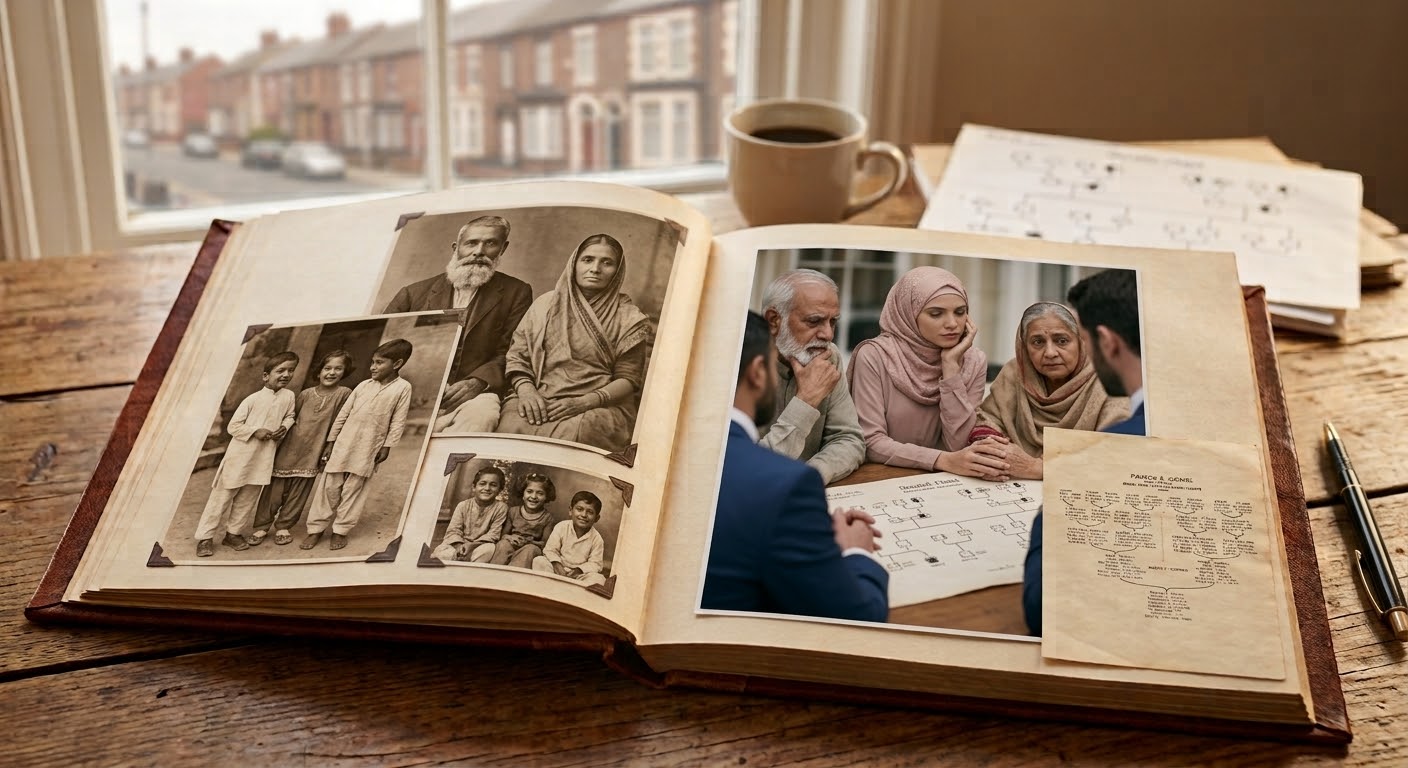
Cousin marriage is one of the world’s most controversial marriage topics.
In many Western societies, the idea can provoke an immediate reaction. Yet marriages between relatives remain common in parts of North Africa, the Middle East, Central and South Asia, and elsewhere.
So what actually drives cousin marriage? What does Islam say about it? What does genetics tell us? And why are marriage patterns changing in places such as Bradford?
These questions deserve something more useful than either condemnation or silence: evidence, context and genuine freedom of choice.
1. Why Is Cousin Marriage So Controversial?
The discomfort surrounding cousin marriage in Western societies is shaped by historical changes in family structures, cultural norms and concerns about inherited health conditions.
But the practice itself is not confined to one religion or culture. Consanguineous marriage has existed across different societies and religious traditions for centuries.
The problem is that discussions about it can quickly become polarised.
One side may treat cousin marriage as simply a cultural tradition that should never be questioned. Another may portray everyone who enters such a marriage as coerced or uninformed.
Neither approach is adequate.
A person can freely choose to marry a cousin. A family can also place significant pressure on someone to marry within the extended family. Those are different realities, and both need to be recognised.
The question should therefore not simply be, “Is cousin marriage good or bad?”
It should be:
Do people have the information, freedom and support to make an informed decision?
2. What Does Islam Actually Say?
Cousin marriage is practised within many faiths, including Islam, Christianity and Judaism.
In Islam, marriage to a first cousin is permitted. The Qur’an’s list of prohibited marital relationships in Surah An-Nisa 4:23 does not include cousins, while Qur’an 33:50 explicitly refers to the daughters of paternal and maternal uncles and aunts among those made lawful to the Prophet. (Quran.com)
That establishes permissibility.
It does not, however, mean that Islam requires Muslims to marry cousins or gives cousin marriage a special religious status.
Egypt’s Dar al-Ifta, for example, explicitly distinguishes between what is permissible and what is recommended, stating that Islam permits cousin marriage but does not make cousins preferable to other potential spouses. (موقع دار الإفتاء المصرية)
There has also been discussion within the classical Islamic tradition about the relative merits of marrying within or outside one’s family. Some scholars discussed potential social and familial consequences of marrying close relatives, while others emphasised the fact that cousin marriage is lawful. The important point is that there is no Islamic obligation to marry a cousin. (Islam-QA)
That distinction matters.
A cultural expectation that “this is what our family does” should not be confused with a religious command.
3. What Does Genetics Tell Us?
This is where the discussion needs particular care.
Humans carry two copies of most genes, one inherited from each biological parent. Some genetic conditions are autosomal recessive: a child generally needs to inherit a disease-causing variant from both parents to be affected.
Two people can carry the same recessive variant without having the condition themselves.
When the parents are biologically related, they are more likely to have inherited the same genetic variants from a shared ancestor. That is why consanguinity can increase the risk of certain recessive conditions.
What is the risk?
The commonly cited figures are approximately:
- 2–3% risk of a genetic condition or congenital anomaly for unrelated couples.
- 4–6% for first-cousin couples.
The important point is that the relative increase sounds larger than the absolute increase.
Moving from approximately 2–3% to 4–6% represents an increase of roughly two to three percentage points.
In other words, most children of first-cousin couples will not have a congenital anomaly or genetic condition attributable to the increased consanguinity risk.
That does not mean the increased risk should be ignored. It means it should be communicated accurately. Add screenshot here
The Born in Bradford research provides particularly useful evidence here. In its original cohort, the rate of congenital anomalies was approximately 2.5% among non-consanguineous couples compared with 6.5% among first-cousin couples. After adjustment for other factors, consanguinity was associated with approximately a doubling of risk. The researchers found that deprivation did not explain the association. (PubMed)
There is another important consideration: repeated consanguinity across generations can increase the likelihood that relatives carry the same recessive variants. The genetic circumstances of an individual family therefore matter.
For anyone considering marriage to a close relative, appropriate medical and genetic advice can help put their individual circumstances into context.
4. Beyond Genetics: Family, Culture and Consent
Genetics is only one part of the conversation.
In some communities, marriage within the extended family can have social and practical advantages.
Families may already know each other’s background, reputation and circumstances. Marriage can strengthen existing relationships between families, maintain social networks and, historically, help keep property or other resources within an extended family.
But the same family structures can also create pressure.
A young person may grow up knowing that a particular cousin is considered a potential spouse. They may worry about disappointing their parents, upsetting relatives or creating conflict by saying no.
That is where an important distinction needs to be made.
Cousin marriage is not the same thing as forced marriage.
Millions of people in cousin marriages enter those relationships willingly.
Forced marriage occurs when someone does not freely consent and pressure or coercion is used to make the marriage happen. Family expectations can exist on a spectrum, from ordinary encouragement through to emotional pressure and, at the most serious end, coercion.
Consent remains essential regardless of the relationship between the two people.
Being related does not create an obligation to marry.
Sharing a culture does not create an obligation to marry.
And family pressure does not replace genuine consent.
5. What Is Happening in Bradford?
Bradford provides one of the most useful case studies for understanding how marriage patterns can change.
The Born in Bradford study began recruiting women in 2007 and has followed the health and development of children born in the city. A second cohort, Born in Bradford’s Better Start, recruited mothers between 2016 and 2019.
The difference between the cohorts is striking.
Among Pakistani-heritage mothers in the original Born in Bradford cohort, approximately 64% were related by blood to the father of their child. In the later cohort, that figure had fallen to approximately 46%. The decline was particularly marked among women who were UK-born, had higher educational attainment and were younger than 25. (PubMed Central (PMC))
Separate analysis of the two cohorts found first-cousin relationships falling from 39.3% to 27% among Pakistani-heritage mothers. (PubMed Central (PMC))
That is a substantial change within roughly a decade.
It tells us something important:
Marriage practices within diaspora communities are not static.
They can change significantly within a single generation.
And that challenges the assumption that a particular marriage tradition is necessarily fixed or permanent.
6. Why Is It Changing?
There is no single explanation.
The Bradford research suggests several overlapping factors, but it is important not to confuse association with causation.
Education
The later cohort contained a greater proportion of Pakistani-heritage mothers with higher educational attainment.
The qualitative research found that participants themselves associated the decline in consanguinity with more people remaining in education beyond school. Younger participants also expressed greater enthusiasm for individual choice in marriage. (PubMed Central (PMC))
Education can also change people’s social networks, economic opportunities and expectations about partner choice.
Birthplace and generational change
The decline was particularly marked among UK-born Pakistani-heritage women.
That suggests birthplace and generational experience may be relevant to changing marriage patterns.
But this should not be reduced to a simple “British versus Pakistani” explanation. People within the same community can hold very different views, and the research itself found differences within generations and groups. (PubMed Central (PMC))
Socioeconomic factors
Economic circumstances can influence marriage decisions.
Historically, extended-family marriage could strengthen social and economic networks. As individuals gain greater educational and economic independence, the practical incentives surrounding family endogamy may change.
But again, this should be treated as part of a wider picture rather than a single proven cause.
Immigration rules
The Bradford qualitative research also identified changes in immigration rules as a factor that participants believed could influence marriage patterns.
The researchers are appropriately cautious about this relationship: they describe the connection as tentative because they did not collect the specific marriage-date and immigration data needed to establish causation. (PubMed Central (PMC))
That is precisely why careful language matters.
Good analysis does not turn a plausible explanation into a proven fact.
7. Is “Marrying Back Home” the Same Conversation?
Not necessarily.
The two issues can overlap, but they are not the same.
Consanguineous marriage means marrying someone to whom you are biologically related, such as a first cousin.
Transnational marriage means marrying someone who lives in, or comes from, another country.
Someone could marry a non-relative from Pakistan. That would be transnational but not consanguineous.
Someone could marry a first cousin who was born and raised in Britain. That would be consanguineous but not necessarily transnational.
And someone could marry a cousin from Pakistan, combining both.
The distinction matters because the considerations are different.
Consanguineous marriage raises questions about genetic inheritance and family dynamics.
Transnational marriage can raise questions about cultural expectations, language, immigration, financial dependence, differences in upbringing and power dynamics.
When both occur together, those considerations can overlap.
That is why “marrying back home” deserves its own conversation rather than being treated as synonymous with cousin marriage.
8. So, Should You Marry Your Cousin?
There is no responsible one-word answer.
A person considering marriage to a cousin should be able to make that decision with the same care they would apply to any major life decision.
Ask yourself:
Would I choose this person if we were not related?
Am I choosing them because we are genuinely compatible, or because my family expects it?
Can we disagree without family pressure determining the outcome?
Do we share compatible expectations about faith, finances, children, work and family life?
Have we understood the relevant genetic considerations?
Where appropriate, prospective couples who are biologically related can seek professional genetic counselling and discuss whether carrier screening is relevant to them.
The purpose is not to tell someone whom they should marry.
It is to ensure that they understand the relevant information before making their decision.
9. Why Are We Having This Conversation?
This is not about condemning a culture or religion.
It is not about telling Muslims that cousin marriage is forbidden when Islamic law permits it.
And it is not about minimising the health considerations simply because the subject is culturally sensitive.
It is about something more fundamental:
Do people have the information, freedom and support to make their own choices?
For generations, difficult questions around marriage have sometimes been handled through silence.
Other times, they have been discussed through stereotypes and condemnation.
Neither approach serves young Muslims well.
An evidence-led approach should be different.
It should acknowledge what Islamic law permits.
It should explain what medical research tells us.
It should distinguish correlation from causation.
It should recognise cultural and family realities.
And above all, it should protect genuine consent.
That is the standard we believe Muslim marriage deserves.
A Different Conversation About Muslim Marriage
At Muslim Marriage Services, we believe marriage should be approached with seriousness, transparency and care.
That means being prepared to discuss subjects that are uncomfortable.
Not because controversy is the goal.
Because informed choice matters.
Whether someone chooses to marry a cousin, someone from their wider community, or someone from another part of the world, the objective remains the same: a marriage built on mutual respect, genuine compatibility, shared values, informed decisions and free consent.
Muslim marriage deserves a higher standard.
Join our Founding 200.
Ameen.
References
BBC https://www.bbc.co.uk/news/uk-67422918
Born in Bradford — congenital anomalies and consanguinity
Sheridan, E. et al. (2013), Risk factors for congenital anomaly in a multiethnic birth cohort: an analysis of the Born in Bradford study, The Lancet, 382(9899), 1350–1359. The study found that congenital anomalies occurred in approximately 2.5% of non-consanguineous couples compared with 6.5% of first-cousin couples, with consanguinity associated with approximately a doubling of risk after adjustment. (PubMed)
Born in Bradford — changing rates of consanguinity
Small, N. et al. (2024), Changes in prevalence and patterns of consanguinity in Bradford, UK – evidence from two cohort studies, Wellcome Open Research, 9:222. This research compares the Born in Bradford and Born in Bradford’s Better Start cohorts and documents the decline in consanguineous and first-cousin unions. (PubMed Central (PMC))
Born in Bradford — understanding why marriage patterns are changing
Small, N., Razaq, R., Sharma, V. et al., Changing patterns in marriage choice and related health risk in the Pakistani heritage community in Bradford UK: a qualitative study, Wellcome Open Research. The focus-group research explored community perspectives on declining consanguinity, education, individual choice, changing social circumstances and immigration rules. The researchers explicitly caution that some proposed explanations, particularly the relationship with immigration-law changes, remain tentative. (PubMed)
Islamic sources
Qur’an 4:23 sets out the categories of relatives prohibited for marriage, while Qur’an 33:50 refers to the daughters of paternal and maternal uncles and aunts as among those made lawful to the Prophet. (Quran.com)
For an accessible contemporary discussion distinguishing permissibility from recommendation, see Egypt’s Dar al-Ifta, Arranged marriages between cousins: is it recommended? (موقع دار الإفتاء المصرية)