

Entering into a marriage is one of the most exciting milestones in life. It is a commitment built on love, mutual trust, and shared dreams for the future. However, alongside the emotional union, marriage is also one of the most legally binding financial contracts you will ever enter.
While no one walks down the aisle anticipating a separation, smart financial literacy means understanding how the law views your wealth. In the United Kingdom, family law operates on principles that shock many newlyweds and long-term couples alike. A common—and dangerous—assumption is that “what’s mine remains mine,” especially if you purchased property before marriage or kept your bank accounts entirely separate.
In reality, the moment you say “I do,” the legal boundaries surrounding individual ownership shift dramatically. UK courts do not prioritize whose name is printed on a bank statement or property deed; instead, they prioritize overall financial need, child welfare, and fairness. Without proactive planning, pre-marital wealth, business equity, and individual pensions can easily be pooled into the marital pot and divided.
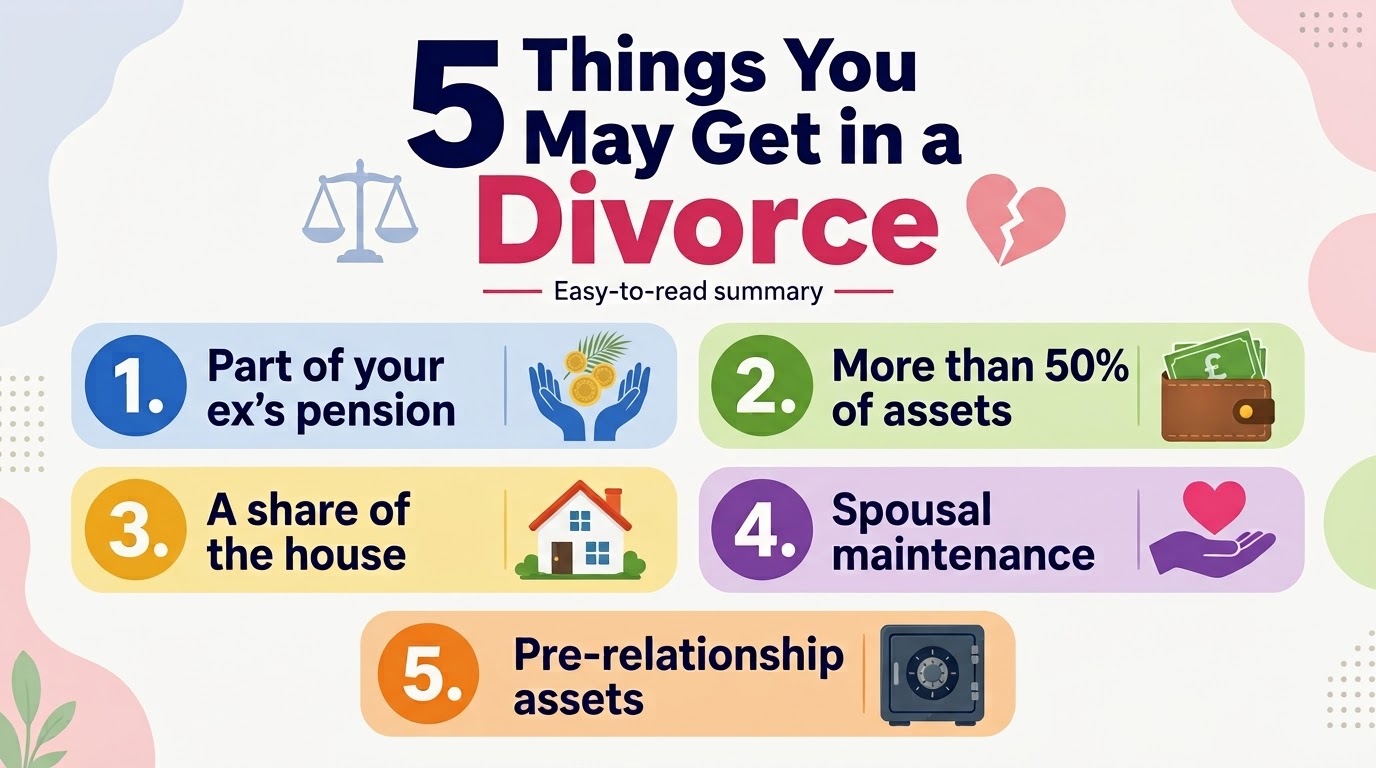
In this guide, we break down the five assets your spouse could claim during a divorce, explore how UK family law actually works, and explain how getting the right legal guidance before marriage can protect both parties, build trust, and secure your long-term financial future.
The Reality of UK Family Law: Need vs. Contribution
To understand why assets are divided the way they are, it helps to understand the core philosophy of the Family Court in England and Wales.
Under the Matrimonial Causes Act 1973, the court’s primary duty is to achieve a fair outcome. “Fairness” does not automatically mean a 50/50 split of what was acquired during the marriage, nor does it mean protecting whatever you brought into the relationship. Instead, the court evaluates a broad range of factors under Section 25 of the Act, prioritizing:
- The welfare of any children under the age of 18 (this is always the court’s paramount consideration).
- The financial needs, obligations, and responsibilities of both parties, both now and in the foreseeable future.
- The standard of living enjoyed by the family before the breakdown of the marriage.
- The age of each party and the duration of the marriage.
- Any physical or mental disability of either party.
- The contributions made by each party to the welfare of the family, including non-financial contributions like caring for the home and raising children.
Because the court places immense weight on financial need and contributions to the home, individual ownership rights often take a backseat. A partner who stayed at home to raise children is viewed as making an equal contribution to the family’s success as the partner who went to work and paid the mortgage.
This brings us to the five major assets that people are often shocked to learn can be divided in a divorce settlement.
1. Part of Your Pension (Equalizing Retirement Security)
For many people, a pension is the single largest financial asset they own—often exceeding the value of the family home. Yet, it is frequently overlooked during pre-marital discussions and early divorce negotiations.
In the UK, pensions accumulated before and during the marriage are treated as marital property. Courts recognize that if one partner was building a substantial workplace or private pension while the other took time off work—or worked part-time—to care for children, the stay-at-home partner would face severe financial hardship in retirement without intervention.
How Courts Divide Pensions
When a marriage ends, courts typically address pensions in one of three ways:
- Pension Sharing Orders: A specific percentage of one party’s pension pot is carved out and transferred directly into a separate pension pot in the other party’s name. This provides immediate, clean-break independence for both individuals.
- Pension Offsetting: The value of the pension is balanced against another asset. For example, one spouse might keep 100% of their pension pot, while the other spouse receives a larger share of equity in the family home to equalize the overall financial split.
- Pension Attachment Orders: A portion of the pension income (or tax-free lump sum) is paid to the ex-spouse when the pension holder eventually retires. (This option is less common today because it does not allow for a true “clean break”).
Without a clear pre-nuptial agreement or financial settlement in place, years or decades of accrued pension wealth can be reallocated to ensure both parties enjoy a similar quality of life in retirement.
2. More Than 50% of Total Marital Assets
There is a widespread myth that divorce settlements always begin and end with a 50/50 split. While 50/50 is often the starting benchmark for long marriages where both parties have similar needs, the court frequently strays far from an equal division.
If there is a significant disparity in earning capacity, or if one parent assumes primary physical custody of the children, the court can—and often does—award 60%, 70%, or even more of the available assets to that spouse.
Why the Balance Shifts Beyond 50%
- Child Custody and Housing Needs: The parent who has primary care of the children needs a stable, long-term home. If selling the house and splitting the proceeds 50/50 means the primary caregiver cannot afford a suitable three-bedroom home in a safe neighborhood, the court will adjust the asset split in their favor.
- Earning Capacity Disparity: If one spouse left a lucrative career to support the family or has limited job prospects due to years outside the workforce, a 50/50 split of current assets leaves them at a massive long-term disadvantage. The court offsets this disparity by giving them a larger upfront share of capital.
- Health or Age Considerations: If one partner has a health condition that prevents them from working full-time, the court must ensure their future living expenses are adequately covered.
In short, the court’s job is not to punish or reward; it is to prevent either party—and especially dependent children—from falling into financial distress.
3. A Share of the Family House (Even If Your Name is Solely on the Deed)
This is perhaps the most common trap for individuals who buy property prior to getting married. You might have saved for a deposit for five years, secured a mortgage in your sole name, and bought a house long before meeting your partner. You might assume that because your name is the only one listed at the Land Registry, the property is exclusively yours.
Under UK law, once you marry and move into that house together, it transforms into the matrimonial home.
The Legal Status of the Matrimonial Home
The family house occupies a unique position in UK divorce law. Regardless of whose name is on the title deed, whose bank account pays the mortgage, or who funded the original deposit, both spouses gain home rights.
When a court evaluates the marital assets, the primary residence is almost always brought into the pool for division. If the marriage lasts several years, or if children are living in the home, the non-owning spouse can claim:
- A substantial share of the equity built up in the home.
- The right to occupy the home until the youngest child reaches 18 (a Mesher Order).
- An order forcing the sale of the house so the proceeds can be divided to rehouse both parties.
Relying on a title deed as a shield against asset division in a divorce is a legal fallacy. Without a formal, legally binding pre-nuptial agreement that explicitly addresses pre-marital property equity, your home is fully exposed.
4. Ongoing Spousal Maintenance Payouts
Many people confuse child maintenance with spousal maintenance, assuming that once the assets are split and child support is calculated, financial obligations to an ex-partner cease.
However, UK courts have the power to order Spousal Maintenance—regular, ongoing payments made by the higher-earning ex-spouse to the lower-earning ex-spouse to help meet their ongoing living expenses.
Key Factors in Spousal Maintenance
- Independent of Child Support: Spousal maintenance is paid in addition to standard Child Maintenance Service (CMS) assessments.
- Standard of Living: Payments are designed to ensure that the lower-earning spouse does not suffer an abrupt, severe drop in their standard of living following the breakdown of the marriage.
- Duration: Depending on the length of the marriage, the recipient’s age, and their employment prospects, spousal maintenance can be awarded for a fixed period (e.g., 3 to 5 years while they retrain for a career) or, in rare cases involving long marriages or elderly parties, for life (“joint lives orders”).
While UK courts increasingly favor a “clean break” where financially feasible, spousal maintenance remains a major financial commitment that can impact your cash flow for years post-divorce.
5. Pre-Relationship Assets and Inheritances
Perhaps the most surprising revelation for individuals entering a marriage is that assets acquired before the relationship—or inheritances received during it—are not automatically safe.
Legally, courts distinguish between matrimonial assets (wealth generated jointly during the marriage) and non-matrimonial assets (pre-existing savings, property owned prior to marriage, family businesses, or inheritances).
In ideal circumstances, courts will try to preserve non-matrimonial assets and leave them with the original owner. However, there is a major catch: The “Need” Exception.
When Non-Matrimonial Assets Get Ring-Fenced—And When They Don’t
If the joint marital assets are insufficient to meet the reasonable housing and living needs of both parties (and their children), the court will seamlessly breach the wall surrounding non-matrimonial wealth.
- Example 1 (Sufficient Wealth): If a couple has £2 million in joint marital property, and one spouse has a pre-marital investment portfolio worth £500,000, the court may easily divide the £2 million and leave the £500,000 investment untouched with its original owner.
- Example 2 (Insufficient Wealth): If the joint marital home only has £100,000 in equity, but one spouse inherited £300,000 from a grandparent, the court will draw from that £300,000 inheritance to ensure both individuals can secure adequate housing.
If pre-relationship assets become mixed with joint finances—such as using pre-marital savings to renovate a joint house or depositing an inheritance into a joint bank account—they lose their non-matrimonial status entirely and become fully ring-fenced marital property.
Why Pre-Marriage Legal Planning is an Act of Wisdom, Not Distrust
Reading through these five points, it is easy to see why so many people feel anxious about marriage and money. But opening a conversation about asset protection is not about preparing for failure; it is about building a foundation of transparency, honesty, and mutual respect.
In many cultures and legal systems worldwide—including Islamic jurisprudence—financial clarity before marriage is heavily emphasized. Defining rights, responsibilities, and assets upfront prevents misunderstandings, eliminates hidden anxieties, and ensures that both partners enter the union with complete clarity.
This is where proactive legal tools like Pre-Nuptial Agreements (Pre-Nups) and Post-Nuptial Agreements come into play.
The Power of a UK Pre-Nuptial Agreement
While pre-nuptial agreements were historically viewed with skepticism by English courts, the landmark Supreme Court ruling in Radmacher v Granatino (2010) fundamentally changed the legal landscape.
Today, UK courts will give decisive weight to a pre-nuptial agreement, provided it meets specific legal criteria:
- It must be freely entered into by both parties, without pressure or coercion.
- Both parties must make full financial disclosure of all their assets, income, and debts.
- Both parties must receive independent legal advice from separate solicitors.
- The agreement must be fair and make adequate provision for the basic needs of both parties and any future children.
- It must be executed well in advance of the wedding date (ideally at least 21 days before).
A professionally drafted pre-nuptial agreement allows couples to agree on how pre-marital property, business equity, and inheritances will be treated, providing total peace of mind for both families.
Introducing Our Global Legal Partner: Aramas Law
Navigating UK family law requires specialized expertise. You cannot rely on generic legal templates or standard contract writers when protecting your family’s financial future. You need dedicated family law experts who understand the nuances of asset protection, international law, and cultural values.
That is why we are proud to partner with Aramas Law, a globally renowned, award-winning family law firm.
Why We Partner with Aramas Law
Aramas Law specializes directly in complex family legal matters, offering compassionate, expert guidance tailored to modern couples and families. Their expertise spans:
- Pre-Nuptial & Post-Nuptial Agreements: Drafting robust, court-ready agreements that protect pre-marital wealth, inheritances, and family businesses while ensuring fair outcomes for both spouses.
- Cross-Border & International Family Law: Providing specialized advice for individuals with assets across multiple jurisdictions, dual nationalities, or international marital ties.
- Divorce & Financial Settlements: Representing clients with skill and sensitivity to achieve fair financial resolutions and protect pension rights.
- Islamic Family Law & Cultural Sensitivity: Offering deep understanding and integration of religious marriage contracts (Nikah), mahr considerations, and legal alignment with UK civil law.
By working alongside Aramas Law, we ensure that our community receives top-tier legal protection, turning complex legal frameworks into actionable, stress-free strategies for long-term peace of mind.
Join Our Community: We Are Onboarding Our Founding 200
Understanding family law and protecting your financial health is only one piece of the puzzle. Wealth preservation, financial literacy, and building a thriving legacy require an ongoing ecosystem of expert guidance, peer support, and trustworthy advice.
That is why we are officially launching our exclusive community and onboarding our Founding 200 members.
What Does It Mean to Be a Founding Member?
We are opening the doors to a select group of 200 visionary individuals, professionals, and couples who want to master their finances, protect their assets, and grow their wealth with confidence.
As one of our Founding 200, you will gain:
- Direct Access to Industry Experts: Exclusive legal insights, financial planning strategies, and Q&A sessions with leading partners like Aramas Law.
- Priority Advisory Services: Fast-tracked consultations and tailored guidance for pre-marriage legal planning, asset management, and wealth structuring.
- Private Community Network: Connect with like-minded individuals focused on building generational wealth, practicing sound financial stewardship, and navigating major life milestones with clarity.
- Lifetime Founding Benefits: Lock in exclusive founding-member rates and early access to all future tools, events, and educational workshops.
Space for our founding cohort is strictly limited to 200 seats to ensure personalized support and high-value networking for every single member.
Take the Next Step Today
Whether you are planning a wedding, looking to protect inherited family assets, or simply want to ensure your financial future is built on solid ground, taking action early is the smartest decision you can make.
Don’t wait for uncertainty to compromise your peace of mind. Let’s start the conversation today.
- Get Expert Legal Advice: If you are getting married soon or want to discuss pre-nuptial arrangements, give us a call for a friendly chat. We will introduce you directly to our global family legal partners at Aramas Law to ensure you receive world-class, confidential legal guidance tailored to your exact needs.
- Secure Your Founding Spot: Be part of something bigger. Visit the link in our bio to apply for one of our Founding 200 community spots before we hit capacity!
We look forward to helping you build a secure, prosperous, and well-protected future.