

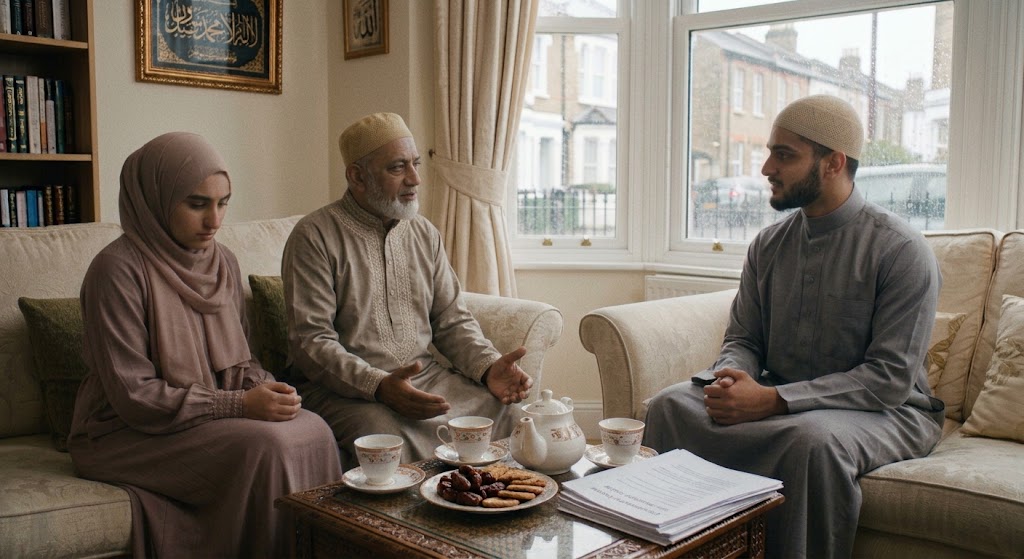
A wali’s responsibility goes far beyond asking a potential husband what he does for a living.
When a man is considering marriage to your daughter, sister or another woman under your care, the questions should help establish whether he has the faith, character, maturity, stability and honesty needed to build a healthy marriage.
A good job title can tell you what someone does for a living.
It cannot tell you how he behaves when he is angry.
It cannot tell you whether he will respect his wife.
It cannot tell you how he handles financial pressure, disagreement, family interference or responsibility.
And it certainly cannot tell you whether he is being completely honest about his circumstances.
That is why a wali should take this responsibility seriously and look beyond the surface.
Islamic marriage is not simply about finding someone who appears suitable on paper. It is about assessing character, compatibility, responsibility and circumstances that could significantly affect a woman’s future.
Here are seven essential categories every wali should cover when evaluating a potential suitor.
1. Deen & Practice
A potential suitor may describe himself as practising, religious or committed to Islam.
But what does that actually mean in his daily life?
A wali should explore his relationship with:
- The five daily prayers
- The Quran
- Islamic obligations
- Halal and haram
- Islamic knowledge
- The mosque and wider Muslim community
- His understanding of marital rights and responsibilities
- His expectations of his future wife
The purpose is not to demand perfection.
Everyone has weaknesses.
The important question is whether his religious commitment is genuine and reflected in his behaviour.
Someone may speak confidently about Islam while treating people poorly. Conversely, someone may not use religious terminology frequently but demonstrate sincerity, humility and strong Islamic character.
The wali should therefore look beyond labels.
Ask what his faith looks like in practice.
2. Character & Conflict
This is one of the most important areas to explore.
A person’s character is often revealed when things do not go their way.
How does he react when he is angry?
How does he respond to criticism?
Can he apologise?
Does he accept responsibility for his mistakes?
How does he handle disagreement?
Does he become aggressive, controlling, dismissive or verbally abusive?
Or can he remain respectful and work towards a solution?
A wali should also consider how the man treats people who cannot offer him anything in return.
How does he treat his parents?
How does he speak about previous relationships or a former wife?
How does he treat colleagues, service workers and strangers?
Does he constantly portray himself as the victim while everyone else is responsible for his problems?
These details matter because marriage inevitably involves disagreement.
Someone who appears charming during the early stages of getting to know another person may behave very differently when faced with stress, disappointment or conflict.
Character should therefore be assessed through behaviour, not simply words.
3. Family & Boundaries
Marriage can bring two families together, but that does not mean every family member should have unlimited involvement in the marriage.
A wali should establish the potential husband’s expectations before the nikah.
Questions should include:
- How involved will parents be in the marriage?
- Will the couple live with his parents?
- How will important decisions be made?
- What boundaries will exist with extended family?
- What happens if there is disagreement between his wife and his family?
- Does he expect his wife to provide regular care for elderly parents?
- What responsibilities does he expect her to have towards his relatives?
- How will private marital matters be handled?
This is particularly important because assumptions can become serious sources of conflict later.
A woman may assume she will have an independent household.
The man may assume she will live with his parents.
Neither assumption is good enough.
These matters should be discussed openly before marriage rather than argued about afterwards.
4. Financial Responsibilities
Money is one of the most important practical issues in marriage, yet couples can sometimes avoid discussing it properly.
A wali should encourage direct and honest conversations about financial responsibility.
This can include:
- Income and employment stability
- Existing debts
- Financial commitments
- Housing costs
- Nafaqah
- Expectations around household expenses
- Whether the wife is expected to work
- Whether her income would remain her own
- Financial support for parents or other relatives
- Attitudes towards saving and spending
The objective is not to determine whether a man is wealthy.
A high income does not automatically make someone financially responsible.
What matters is whether he understands his obligations, lives within his means, is honest about his circumstances and has a realistic plan for supporting a household.
Financial problems that are hidden before marriage rarely become easier afterwards.
Transparency is essential.
5. Home & Location
Where will the couple actually live?
This may sound straightforward, but it can reveal major differences in expectations.
A wali should establish:
- Where the couple intends to live
- Whether the home will be independent
- Whether they will live with parents
- Whether relocation is expected
- Whether moving cities or countries is being considered
- What happens if employment requires relocation
- Whether the proposed home is realistically affordable
- What level of privacy the wife can expect
Location can affect employment, education, childcare, family relationships and the couple’s wider support network.
It is therefore not simply a logistical detail.
A marriage can become extremely difficult when one person believes they are agreeing to one lifestyle while the other has a completely different expectation.
Clarity before marriage prevents avoidable conflict afterwards.
6. Children & Parenting
Wanting children is only the beginning of the conversation.
A wali should encourage the couple to discuss their expectations about:
- Whether they want children
- When they would ideally like to have children
- Family size
- Parenting responsibilities
- Education
- Islamic upbringing
- Schooling
- Discipline
- Technology and social media
- Religious education
- The role of extended family
The couple should also be prepared to discuss what happens if circumstances change.
There is no guarantee that marriage, pregnancy or family life will follow the exact plan someone has imagined.
The important thing is that both people understand each other’s expectations and can discuss difficult subjects maturely.
A child will not resolve incompatibility between parents.
Strong marriages require parents who can work together rather than compete over how their children should be raised.
7. Health & Honesty
This category requires particular sensitivity.
Marriage requires meaningful transparency about circumstances that could materially affect the other person’s decision.
Depending on the circumstances, this may include:
- Previous marriages
- Children from previous relationships
- Significant physical health conditions
- Relevant mental health history
- Fertility-related concerns where appropriate
- Criminal or legal matters that materially affect the marriage
- Financial circumstances that could affect the household
- Other significant information that a prospective spouse reasonably needs to know
This does not mean demanding someone’s entire private medical history or treating a health condition as a reason to reject someone.
It means ensuring that material information is not deliberately concealed.
A person has the right to make an informed decision about marriage.
Honesty should also work both ways. The same principle applies to the woman.
A wali’s role is not simply to investigate the man while ignoring the woman’s responsibility to be honest about matters that could materially affect the marriage.
Transparency protects both sides.
Questions Are Not an Attack
Some people may feel uncomfortable with this level of questioning.
But serious questions are not automatically disrespectful.
A man who genuinely understands the responsibility of marriage should recognise why a wali wants clarity.
A good suitor should not be threatened simply because someone asks about his finances, family expectations, religious practice, health, previous marriage or approach to conflict.
His willingness to answer reasonable questions respectfully can itself reveal something about his character.
At the same time, a wali should avoid turning the process into an interrogation designed to find fault.
The objective is not perfection.
The objective is informed decision-making.
A wali should listen to what the man says, but should also consider whether his actions support his claims.
Words matter. Behaviour matters more.
Look Beyond the Job Title
One of the easiest mistakes in evaluating a potential husband is to focus heavily on his profession.
“Doctor.”
“Engineer.”
“Business owner.”
“Accountant.”
“IT professional.”
These descriptions may tell you something about his career.
They tell you very little about the man who may enter your daughter’s or sister’s life.
Ask the harder questions.
How does he handle anger?
How does he deal with money?
What does he believe a husband’s responsibilities are?
How does he treat women?
How does he handle disagreement?
What boundaries does he expect with his family?
Is he honest about his past and present circumstances?
What kind of father does he intend to be?
These are the questions that can reveal whether the foundations for marriage are actually there.
The Wali’s Responsibility Is About Protection, Not Control
There is an important distinction between protecting someone and controlling them.
A wali should not make decisions based solely on personal preferences, social status, ethnicity, wealth, occupation or family reputation.
Nor should a woman be treated as incapable of making decisions about her own future.
The role should involve guidance, due diligence, safeguarding and asking the questions that a potential spouse may not think to ask himself.
The woman herself should be able to ask questions, express concerns and make her own informed decision within the applicable Islamic framework.
The strongest approach is therefore not:
“I will decide for you.”
It is:
“I will help you ask the questions that deserve answers.”
What About Red Flags?
Sometimes the answers themselves are not the only warning sign.
Pay attention to how a potential suitor reacts to reasonable scrutiny.
Does he become defensive whenever financial questions are raised?
Does he refuse to discuss previous marriages?
Does he become angry when boundaries are discussed?
Does he dismiss legitimate concerns?
Does his story change?
Does he pressure everyone to move quickly?
Does he insist that certain subjects are “none of your business”?
Does he expect complete transparency from the woman while demanding privacy for himself?
None of these behaviours automatically proves that someone is unsuitable.
But they can justify slowing down and asking further questions.
Marriage is a major life decision.
There is no prize for rushing into it.
Due Diligence Should Not Stop at the Conversation
Questions are important, but they are only one part of responsible due diligence.
Where appropriate and lawful, information should be verified rather than simply accepted because someone says it confidently.
This is particularly relevant to modern marriage introductions, where people may live in different cities or countries and much of the early communication can happen digitally.
A person’s online presentation may not tell the whole story.
Neither should a carefully constructed profile.
This is one reason digital identity, security and safeguarding are becoming increasingly important in modern Muslim marriage services.
Trust should be built on transparency, not assumptions.
A Modern Muslim Marriage Service Needs More Than Profiles
The principles of responsible due diligence have not changed.
But the environment in which people meet has changed dramatically.
People now encounter potential marriage partners through websites, social media, messaging platforms and video calls. That creates opportunities — but it also creates new risks.
A modern Muslim marriage service therefore has a responsibility to take trust, transparency, safeguarding and digital security seriously.
At Muslim Marriage Services (MMS), we are building a Muslim Marriage Sanctuary around those principles.
Our approach is centred on trust, transparency and digital security, with safeguards designed for the realities of modern Muslim marriage.
We are currently working towards our Founding 200.
If you believe Muslim marriage should involve more than simply browsing profiles, and that trust should be built into the process from the beginning, comment “Pioneer” or send us a DM to learn more.
Final Thought for Every Wali
A wali does not need to find a perfect man.
Nobody is perfect.
The responsibility is to help ensure that a woman is not making one of the biggest decisions of her life based solely on a job title, a polished profile, family reputation or a few pleasant conversations.
Look at deen.
Look at character.
Look at responsibility.
Look at compatibility.
Look at honesty.
And look at how the man responds when serious questions are asked.
A suitor with sound character should understand that these questions are not an insult.
They are part of taking marriage seriously.
Because protecting someone’s future requires looking beyond the surface.