

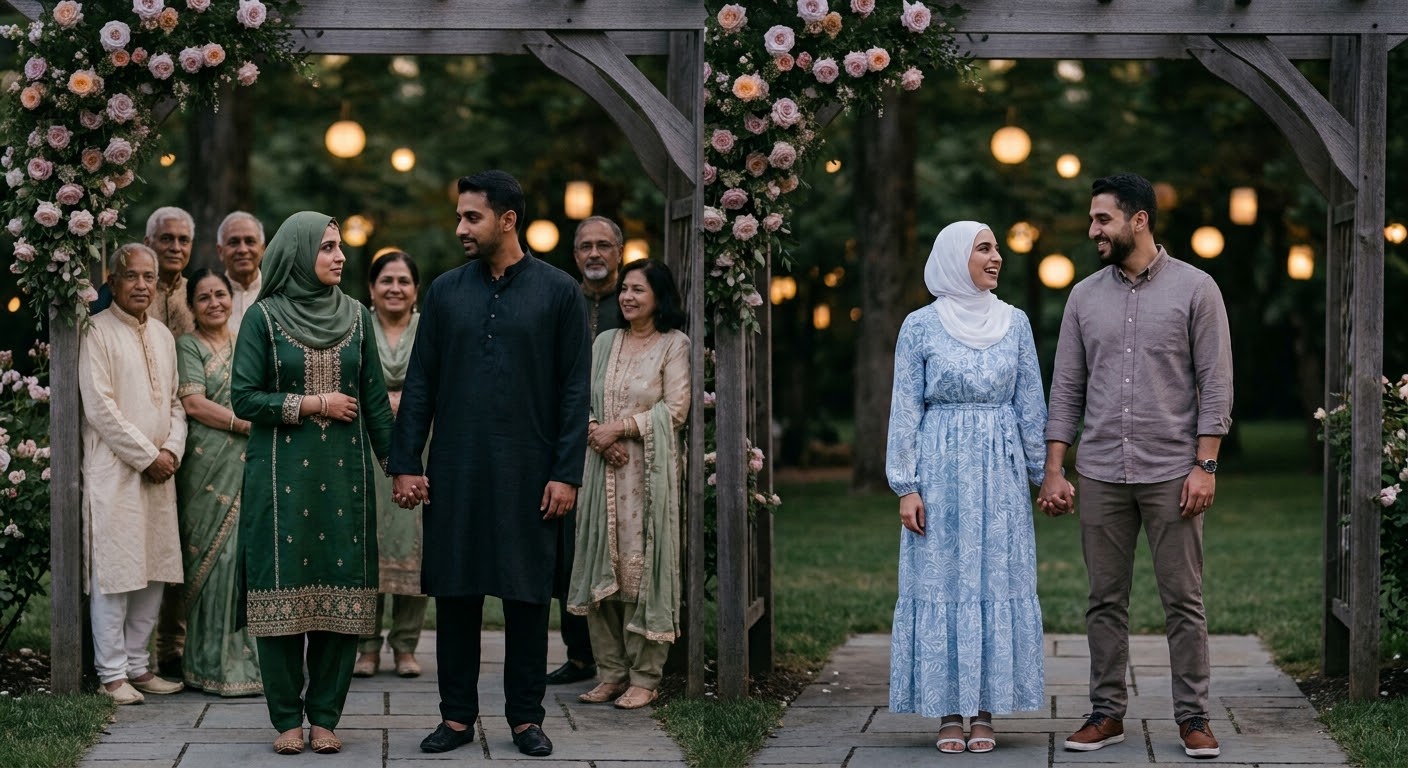
Many people assume arranged marriages last longer than love marriages because they are associated with lower reported divorce rates. Some believe family involvement encourages compatibility and shared values, while others argue that love marriages have an advantage because couples choose each other through romantic attraction.
But does the research support this belief?
The answer is more complicated than you might expect.
Some couples meet through their families and build happy, lasting marriages. Others fall in love independently and establish equally strong partnerships. Unfortunately, both arranged and love marriages can experience difficulties and end in divorce.
The important question is not simply how two people meet. It is whether they have the qualities needed to build a healthy, lasting relationship.
At Muslim Marriage Services (MMS), we believe that finding a life partner deserves careful consideration. Marriage involves more than initial attraction or family approval. It requires character, compatibility, communication, trust and commitment.
So, what does the research actually tell us?
1. What is the difference between arranged and love marriages?
An arranged marriage generally involves family members or trusted individuals helping to introduce potential marriage partners. This may include discussing religious values, family backgrounds, character and long-term compatibility.
However, arranged marriages vary considerably. Some families suggest potential partners while leaving the final decision entirely to the individuals concerned. In other situations, family involvement is much greater.
A love marriage, meanwhile, usually describes a marriage in which two people choose each other, often after developing romantic feelings.
In practice, the distinction is not always clear-cut. A couple introduced by their families may develop a strong emotional connection before deciding to marry. Equally, a couple who meet independently may rely on their families for advice and guidance.
Neither approach guarantees success.
Family involvement can provide valuable support, but it should never replace personal choice. Similarly, romantic attraction can bring two people together, but it cannot guarantee that they are compatible.
The starting point matters, but it does not determine everything that follows.
2. What did the 2012 study of Indian-American marriages find?
A study by Pamela C. Regan, Saloni Lakhanpal and Carlos Anguiano, published in Psychological Reports in 2012, compared relationship outcomes among Indian adults living in the United States.
The researchers studied 58 participants: 28 in arranged marriages and 30 in love-based marriages.
They examined four areas:
- Marital satisfaction.
- Commitment to the relationship.
- Companionate love, including affection and emotional closeness.
- Passionate love, involving romantic and passionate feelings.
The researchers found no statistically significant differences between the two groups in these areas. Participants in both arranged and love-based marriages reported high levels of love, satisfaction and commitment. <Cite refs={[“turn247987search0”,“turn247987search6”]}/>
These findings challenge the assumption that arranged marriages necessarily lack love or that choosing a partner independently automatically produces a more satisfying relationship.
However, there are important limitations.
The sample was small and restricted to Indian adults living in the United States. A separate academic commentary subsequently highlighted how the small sample limited the conclusions that could reasonably be drawn. <Cite refs={[“turn247987search3”,“turn247987search5”]}/>
The study also examined reported relationship outcomes, not whether one type of marriage lasted longer or had a lower divorce rate.
It therefore provides useful evidence about love and satisfaction, but it does not prove that arranged and love marriages have identical long-term outcomes.
3. What does more recent international research tell us?
A study published in Archives of Sexual Behavior in 2025 examined love in arranged and freely chosen marriages across five non-Western societies.
The researchers studied married people from communities in the Himalayas, Nigeria, Kenya, Tanzania and Bolivia.
They examined three dimensions of love:
- Intimacy: emotional closeness, trust and friendship.
- Passion: romantic attraction and desire.
- Commitment: the intention to maintain the relationship.
When the researchers analysed the combined data from all five populations, they found no statistically significant difference in average love scores between arranged and freely chosen marriages. However, differences emerged when some populations were examined separately. <Cite refs={[“turn247987search1”,“turn247987search2”]}/>
The findings challenge the idea that arranged marriages cannot develop into loving relationships. They also demonstrate that cultural circumstances can influence how people experience marriage.
Nevertheless, this study did not establish that arranged marriages have lower divorce rates or last longer. Its focus was on aspects of love, rather than a direct comparison of marital longevity.
Taken together, these two studies suggest that we should be cautious about assuming one route into marriage is automatically better than another.
More research is needed before we can draw firm conclusions about which type of marriage is more likely to last.
4. Do lower divorce rates mean arranged marriages are more successful?
This is an important distinction.
Even if a community reports fewer divorces, that does not automatically mean its marriages are happier or healthier.
Several factors can influence whether couples separate.
Cultural expectations: In some communities, divorce carries considerable stigma. Couples may face pressure from relatives or their wider community to remain married, even when the relationship is deeply unhappy.
Financial circumstances: Shared housing, children, financial dependence and the cost of establishing separate households can make separation difficult.
Family and religious considerations: Religious beliefs and family responsibilities may encourage couples to seek reconciliation and work through difficulties. However, fear of judgement or disappointing relatives can also prevent people from seeking help.
Different reporting methods: Comparisons between countries may use different definitions, population measures and reporting periods. Annual divorce figures alone cannot reliably establish which type of marriage is more stable.
These factors do not mean that every couple who remains married is unhappy. Many couples overcome difficulties and build stronger relationships through patience, communication and mutual effort.
The point is that divorce statistics cannot tell the whole story.
A marriage that continues is not necessarily a marriage that is thriving. Equally, the fact that a marriage ends does not automatically mean that the decision to marry was wrong.
Lasting marriage matters, but so do happiness, respect, emotional wellbeing and personal safety.
The goal should be to build a healthy relationship, not simply to avoid divorce at any cost.
5. Why family involvement can be valuable
Family guidance can offer real benefits when it supports the choices of the people getting married.
Relatives may know a person’s character, background, habits and values. They may also raise practical questions that a couple experiencing the excitement of a new relationship has not yet considered.
For example, families may encourage prospective partners to discuss religious beliefs, financial responsibilities, career ambitions, plans for children and expectations about extended family.
These conversations can help identify important differences before marriage.
Family members may also provide emotional and practical support when couples encounter difficulties later.
However, family involvement is beneficial only when it respects the individuals concerned.
Parents and relatives may have good intentions, but their preferred match will not necessarily be the right match. A person’s concerns about compatibility should not be dismissed simply because a family has approved the marriage.
An introduction is an opportunity to learn about someone. It is not proof that the two people are suitable for each other.
Most importantly, both individuals must be free to make their own informed decision. Family pressure or coercion should never be mistaken for successful matchmaking.
6. Why falling in love does not guarantee a lasting marriage
Romantic attraction can be an important part of a relationship. Falling in love may create excitement, affection and a powerful desire to build a future together.
However, love alone does not guarantee compatibility.
I have known people whose love marriages unfortunately ended in divorce. Their experiences remind us that strong feelings at the beginning of a relationship cannot, by themselves, predict its long-term outcome.
Two people may be deeply attracted to each other but have very different expectations about money, children, religious practice, careers or family responsibilities.
They may also struggle to communicate when disagreements arise. One partner may expect the other to change after marriage, or they may discover that they approach commitment and responsibility differently.
These differences do not automatically mean that a relationship cannot succeed. Many can be addressed through honest communication and a willingness to work together.
However, they should not be ignored simply because two people are in love.
Romantic feelings can also change over time. The excitement of a new relationship may develop into a deeper attachment built on friendship, trust and shared experiences.
That change does not necessarily mean love has disappeared. It may reflect the development of a different kind of closeness.
What matters is whether both partners continue to respect, understand and support one another.
Love can bring two people together, but compatibility, communication and mutual effort help them build a lasting partnership.
7. What matters most when choosing a life partner?
Regardless of how two people meet, certain qualities are important when considering marriage.
Character and integrity
Is the person honest? Do their actions match their words? How do they treat other people, particularly when they have nothing to gain?
Character is revealed through consistent behaviour, not simply promises made during the early stages of a relationship.
Compatibility
Compatibility does not mean agreeing on everything. It means understanding each other’s values, priorities and expectations, and deciding whether differences can be managed constructively.
Communication
Can you discuss difficult subjects without immediately becoming defensive? Can you listen to another person’s concerns and work towards solutions?
Healthy communication helps couples address problems before resentment builds.
Trust and transparency
Trust develops when people communicate honestly, behave consistently and respect appropriate boundaries. Important information should not be concealed simply to secure a marriage proposal.
Commitment and responsibility
Commitment involves taking responsibility for the relationship, making a genuine effort to resolve disagreements and recognising that both partners have needs.
It should be mutual. It must not mean that one person continually sacrifices their wellbeing while the other refuses to change.
Emotional maturity
Marriage brings challenges, including financial pressures, family responsibilities and changing circumstances. Emotional maturity helps people manage frustration, acknowledge mistakes and respond to disagreements respectfully.
These qualities are relevant whether a couple meets through family introductions, a marriage event or their own social circle.
8. Preparing for marriage rather than relying on first impressions
People often spend considerable time thinking about how to meet a potential spouse. It is equally important to consider what they need to know before deciding to marry.
A brief conversation can provide an initial impression, but it cannot reveal everything about someone’s character, values or behaviour under pressure.
Prospective partners should have meaningful conversations about their expectations and future plans.
Questions worth considering include:
- What does a successful marriage mean to each of us?
- How do we approach disagreements?
- What are our expectations regarding faith and religious practice?
- Do we want children, and how do we view parenting?
- How will we manage financial responsibilities?
- What role will our families play in our married life?
- How do we understand privacy, trust and personal boundaries?
These conversations cannot remove every uncertainty. No one can predict exactly how another person will respond to every future challenge.
However, they can reveal important differences and support a more informed decision.
The aim is not to find someone without imperfections. It is to find a person whose character, values and expectations are compatible with yours, and who is willing to build a relationship based on mutual respect.
9. How does this relate to Muslim marriage?
For Muslims, marriage involves personal choice, family considerations and religious responsibilities.
Family consultation and shared values can play a meaningful role in choosing a spouse. However, neither family approval nor romantic attraction should replace careful consideration of the individual.
Muslims seeking marriage should have the opportunity to assess character, discuss compatibility and ask important questions without coercion.
An arranged introduction can be a valuable way to meet someone. Equally, meeting independently can lead to a successful marriage.
Neither route removes the need for honesty, sensible checks and thoughtful decision-making.
People also have different circumstances and preferences. Some welcome substantial family involvement, while others prefer a more independent approach. Some develop affection gradually, while others experience strong initial attraction.
There is no need to assume that everyone must follow the same path.
What matters is that the process respects both individuals and supports an informed, voluntary decision.
10. The MMS approach: Trust, security and responsibility
At Muslim Marriage Services (MMS), we are building a more secure, trust-centred approach to Muslim marriage.
Our focus is not simply on bringing people together. We believe the process should take seriously the responsibility involved in finding a life partner.
Identity verification and fraud screening can help address certain risks associated with online introductions. However, these measures cannot guarantee someone’s character, establish compatibility or promise a successful marriage.
That is why digital security should sit alongside meaningful conversations, realistic expectations and careful consideration of suitability.
Our ambition is to encourage a more responsible approach to Muslim marriage, with trust and security at its foundation.
We are inviting interested people to express their interest in our Founding 200 initiative and help shape the next stage of MMS.
We are not competing on numbers. We are competing on trust, security and responsibility.
Conclusion: How you meet matters less than what you build
So, do arranged marriages actually outlast love marriages?
The honest answer is that the research discussed here does not establish that arranged marriages universally last longer.
The 2012 Indian-American study found no significant differences in reported love, commitment or satisfaction between the two groups, although its small sample limits the conclusions. The 2025 international study likewise found no significant overall difference in average love scores across five populations, while identifying some differences between individual communities.
Neither study proves that arranged marriages have lower divorce rates.
Arranged marriages can flourish, and love marriages can flourish. Both can also encounter serious difficulties.
Family involvement may provide valuable guidance, while romantic attraction can create an important emotional connection. Neither guarantees success.
Lasting relationships require character, compatibility, communication, trust, commitment and a willingness to take responsibility for the relationship.
Just as importantly, staying together should not automatically be confused with being happy. A healthy marriage should provide mutual respect, emotional security and the opportunity for both partners to express their needs.
Ultimately, the question is not simply whether a marriage was arranged or based on romantic love.
It is whether two people can build a life together in which both feel respected, valued and supported.
At Muslim Marriage Services, we believe that how you meet matters less than what you build together.
If a more secure, trust-centred approach to Muslim marriage matters to you, comment “Pioneer” or send us a direct message to express your interest in our Founding 200.
Ameen.
References
- Regan, P. C., Lakhanpal, S. and Anguiano, C. (2012). Relationship Outcomes in Indian-American Love-Based and Arranged Marriages. Psychological Reports, 110(3), 915–924.
The study compared relationship satisfaction, commitment and love among 58 Indian adults living in the United States.
- Johnson, D. R. and Bachan, L. K. (2013). What Can We Learn from Studies Based on Small Sample Sizes? Comment on Regan, Lakhanpal, and Anguiano (2012). Psychological Reports, 113(1), 1233–1236.
This commentary explains why the small sample in the 2012 study limits the conclusions that can be drawn.
- Sorokowski, P. et al. (2025). Love Components in Free-Choice and Arranged Marriages Among Five Non-Western Populations From Africa, Amazonia, and Himalayas. Archives of Sexual Behavior, 54, 85–94.
This study compared intimacy, passion and commitment in arranged and freely chosen marriages across five non-Western populations.
Research note: These studies examine aspects of love and relationship satisfaction, not a definitive comparison of divorce rates. Their findings should not be presented as proof that either type of marriage lasts longer.