
Back in 2015, I went to a South Asian marriage event in Manchester looking for a high-level partner with real character and Deen. I went in with optimism, expecting to connect with individuals who valued spiritual alignment and intellect over superficiality.
Within thirty seconds, I faced the casual racism that quietly plagues modern matchmaking.
A girl walked up, looked me up and down, and asked: “Are you Pakistani by any chance?”
I smiled: “No, I’m Bangladeshi. Is that a problem?”
She visibly froze, completely lost without her regional criteria. I just said, “Good luck getting married,” and walked away.
Why is anyone’s first question in a room full of Muslims about an ethnic checklist instead of values, intellect, or spiritual alignment? People routinely use geography and ethnicity as a lazy shortcut, reducing brothers and sisters to regional stereotypes.
Between that absurd encounter and watching my closest, high-caliber friends struggle for years with those exact same superficial barriers, I knew the entire system was fundamentally broken. Good people were being filtered out for all the wrong reasons.
To understand why this happens so frequently today, we have to look at how the traditional marriage ecosystem fell apart when it moved to the West—and how we can rebuild it with integrity.
1. The Geography of Trust: When the Village Handled the Vetting
Once upon a time, finding a spouse was a deeply collective effort. Across Pakistan, India, and Bangladesh, the traditional rishta system didn’t just exist; it thrived as a highly reliable social ecosystem. In these close-knit environments, communities relied on local matchmakers—often the well-connected neighborhood “aunties”—who possessed a mental encyclopedia of every single family within a five-mile radius.
If you wanted to know about a young man’s character or a young woman’s temperament, you didn’t ask for a digital resume. You simply asked your neighbor.
This historic system worked because it was built on three core pillars:
- Geographic Closeness: People lived, worked, and worshipped in the same tight spaces. Families had deep, visible roots in the community. Reputation was the ultimate social currency.
- Built-In Verification: The neighborhood matchmaker had watched the children grow up and knew their standing in the community. Vetting was based on years of direct, personal observation.
- Zero Burden on the Couple: The community and families did the heavy lifting, stepping in to protect both parties before they ever met.
This approach worked for a specific time and place. However, when those communities migrated to modern Britain, they brought the traditional rishta system along in their suitcases—but they left behind the physical environment, the shared village, and the deep local networks that actually made it work.
2. Fractured Networks: Why Matchmaking Is Broken in the West
In modern Britain, almost every single one of those traditional safety nets has vanished. The British Muslim diaspora is spread out across bustling metropolises, quiet suburbs, and rural towns from London to Glasgow.
The Modern Dilemma: A traditional matchmaker living in London simply has no way of truly verifying a family living all the way in Scotland. The organic, trusted networks of the past do not exist at this scale.
Because we tried to copy-paste an old-world system into a busy, modern landscape, the matchmaking process has fractured into several major problems:
The Ethnic Checklist & Lazy Stereotypes
When shared village networks disappear, people default to crude demographic filters. As I experienced firsthand in Manchester, candidates are routinely judged by where their parents were born rather than their personal integrity, Akhlaq(character), or psychological readiness for marriage.
The Information Vacuum
Without a shared neighborhood, parents are forced to make massive, life-altering decisions based on complete guesswork. Relying on distant acquaintances turns finding a partner into a high-stakes lottery.
The Generational Shift
Second and third-generation British Muslims want to find someone with shared intellectual values, emotional maturity, and spiritual compatibility. They want to actually talk and connect, yet traditional setups rarely allow space for these deeper, necessary conversations.
Privacy and Gossip Nightmares
Because the old system lacked structure, young people’s private photos, home addresses, and personal biodatas are routinely forwarded across casual WhatsApp group chats—stripping individuals of their dignity and exposing them to widespread community gossip.
3. Bridging the Gap: Building a Modern, Safe, and Halal Path
At Muslim Marriage Services (MMS), we believe that the core values of the traditional marriage process—family involvement, pure intentions, chaperoned interactions, and treating commitment with seriousness—are completely worth preserving. However, the tools we use must fit the world we actually live in today.
In an era where online romance scams cost UK victims over £106 million in a single year, relying on blind trust is no longer just outdated—it is dangerous.
That is why I founded MMS—a certified social enterprise Sharia-compliant sanctuary where candidates are evaluated on digitally verified identity, Big 5 compatibility, and true character. We replaced the old village network with state-of-the-art digital security:
a. Digitally Verified Identity
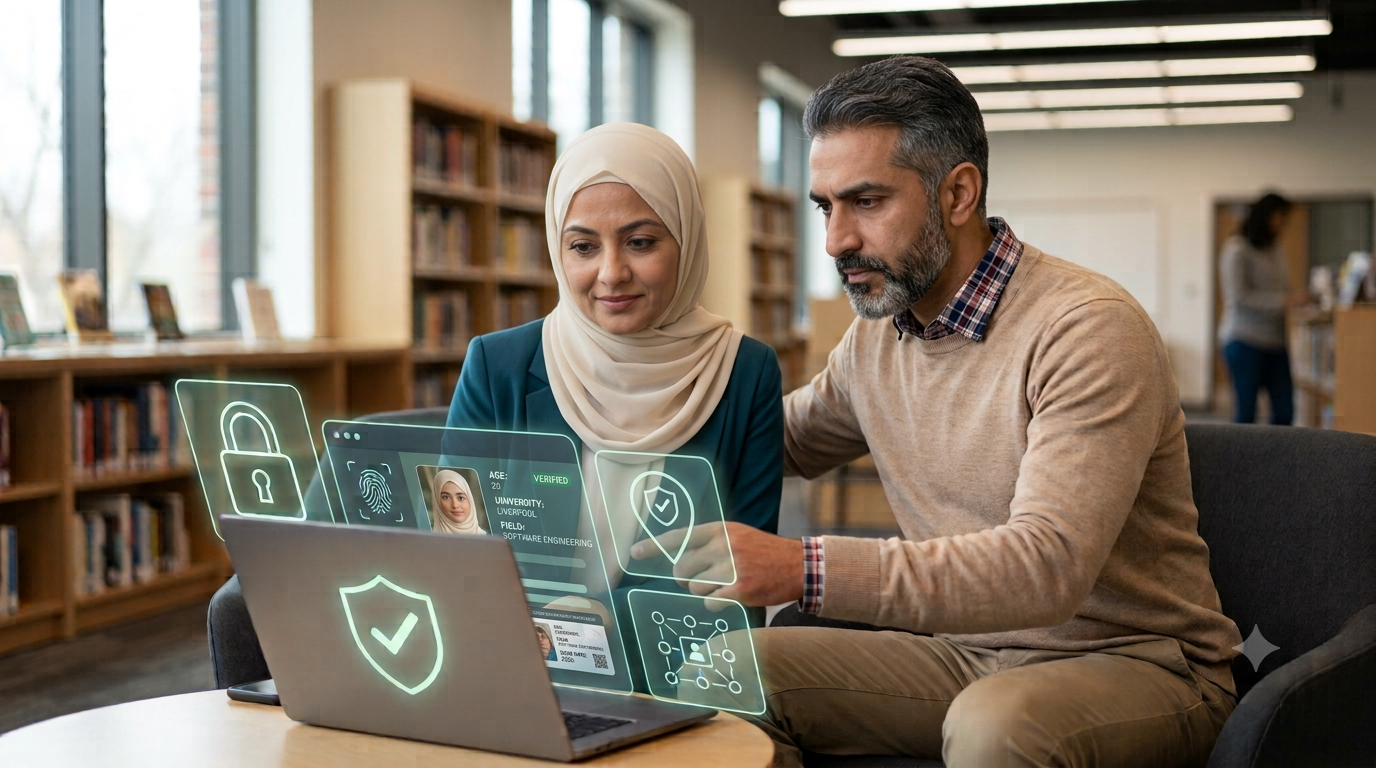
The biggest fear in online matchmaking is not knowing if a person is real. MMS completely solves this by partnering with Yoti, a world leader in AI-driven biometric identity solutions. Every member must verify their ID, completely eliminating fake profiles and bad actors.
b. DynamIQ Guardian™ (Halal Chaperoning)
In the traditional system, families kept the process safe by being physically present. We digitised this protection. Our DynamIQ Guardian™ feature allows users to add a mahram (chaperone) to monitor chats, keeping conversations respectful, transparent, and aligned with Islamic values.
c. ProfileShield™ (Total Privacy)
You should never have to compromise your dignity to find a spouse. With ProfileShield™, your photos and personal details remain fully protected under your direct control, bypassing invasive gossip networks and leaked WhatsApp groups.
d. Big 5 Compatibility & Character-First Matching
Instead of filtering people out based on regional boxes, we use the Big 5 Personality Framework alongside verified identity metrics. We evaluate how a potential partner handles stress, communicates, and aligns with your long-term spiritual vision.
Marriage Isn’t a Checklist—It’s a Legacy
Marriage isn’t about ticking regional boxes, matching an ethnic checklist, or settling for broken, outdated systems. It is about building a legacy with a partner who shares your core values, your faith, and your vision for the future.
We built Muslim Marriage Services to ensure that no one ever has to sit in a room and be written off in thirty seconds because of where their family originated. It’s time to move past superficial shortcuts and demand a higher standard for ourselves and our community.
Ready to find a partner based on true character and verified trust?
Discover a safe, dignified, and intentional way forward at Muslim Marriage Services.