
 When Words Become Weapons
In today’s hyper-connected age, social media can elevate your voice—or destroy it. Online spaces that once promised community and opportunity now teem with hostility, misinformation, and public shaming. What was once a forum for respectful discussion has, in many cases, become a platform where reputations are torn apart with a few careless words.
Whether you are a professional, entrepreneur, or someone simply trying to build meaningful connections, the digital world presents invisible dangers. Bullying, Slander, and Gang Mentality thrive in these virtual environments, often disguised as “honest opinion” or “community debate.” Yet, their effects are far from harmless. A single false post can damage your trust, your business, your relationships, and even your marriage prospects.
In this guide, inspired by real-life experiences from MMS’ founder, Hajji Laird Mostafa, we will explore these behaviours, their devastating consequences, and how to defend yourself ethically, legally, and spiritually against them.
Online Bullying — Recognising and Resisting Digital Aggression
Invisible Attacks, Real Consequences
Online bullying does not leave visible bruises, but its emotional scars run deep. It can start with subtle insults or sarcastic remarks before escalating into open hostility. Recent statistics from the UK show a disturbing rise in digital abuse cases, particularly among young adults and professionals who use online networks to build trust-based relationships or find marriage partners.
It often begins with miscommunication. A simple interaction—a polite conversation, a shared post—can quickly be twisted into something malicious. Unfortunately, once this distortion spreads, it becomes a breeding ground for bullying. For some, this means being targeted in group chats, mocked in public comment sections, or “cancelled” based on rumours rather than evidence.
Signs You Might Be Experiencing Bullying
Recognising digital harassment early is key to reclaiming control. Common warning signs include:
- Repeated personal attacks disguised as “feedback.”
- Misrepresentation of your actions or words.
- Pressure to apologise, delete content, or remain silent.
- Emotional intimidation through insults or manipulative messaging.
These tactics aim to exhaust you emotionally and socially—isolating you from your peers or support networks. Yet, you are not powerless.
Defensive Strategies to Protect Your Peace and Mental Health
The first line of defence against digital bullying is evidence. Document every exchange—screenshots, timestamps, and correspondence. These records can support your case if the abuse escalates and also provide psychological validation: proof that what you are experiencing is real and not your imagination.
Secondly, protect your mental peace. Block or mute abusers instead of engaging directly. Public retaliation often feeds the aggressor’s ego and escalates the conflict. Remaining calm, professional, and composed demonstrates maturity and prevents further harm.
In serious cases, do not hesitate to report abuse to the authorities. Many jurisdictions treat persistent online harassment as a criminal offence. Online violence is not “just social media drama”; it can cross into legal boundaries, affecting your safety and livelihood.
Slander — The Quiet Saboteur of Reputation
The Cost of False Narratives
Slander is one of the most destructive forms of digital harm because it attacks your greatest asset: your reputation. Once false or misleading claims are circulated, damage occurs swiftly—often before you have a chance to respond. In professional and faith-based communities, this can have profound consequences, especially when integrity and honesty form the foundation of trust.
In my own experience, even after providing transparent proof of platonic, halal, and respectful communication, false narratives continued circulating. Facts were ignored in favour of inflammatory storytelling. This not only impacted personal relationships but also professional collaborations. Such incidents reveal how digital ecosystems crave drama over truth.
Understanding the Mechanics of Slander
Slander operates on repetition and perception. The more a false statement is repeated, the more credible it appears to casual observers. Those sharing or amplifying misinformation often justify it as “sharing awareness” or “protecting others,” without verifying the facts. This emotion-based behaviour spreads quickly, and before long, a person’s character is judged by a false story repeated across platforms.
The consequences are severe. Slander can:
- Destroy friendships and social trust.
- Undermine community reputation.
- Ruin business prospects and professional opportunities.
Once a rumour takes hold, reversing its impact requires time, patience, and a principled approach.
Practical and Ethical Protection from Slander
- Document everything: Just as with bullying, meticulous records are invaluable. Save copies of false statements, messages, and posts.
- Stay professional: Responding with anger often validates the slanderer’s narrative. Remain calm, precise, and truthful.
- Seek legal recourse: UK civil law allows individuals to bring defamation claims against those who spread false information that harms personal or business reputation.
- Report harassment: When slander overlaps with harassment, authorities may intervene under digital communications or harassment laws.
Above all, remember: your reputation is an amanah (trust). Guard it with dignity, patience, and evidence-based responses. It is a moral duty to protect your name and your truth.
Gang Mentality — When the Crowd Turns Hostile
From Disagreement to Mob Behaviour
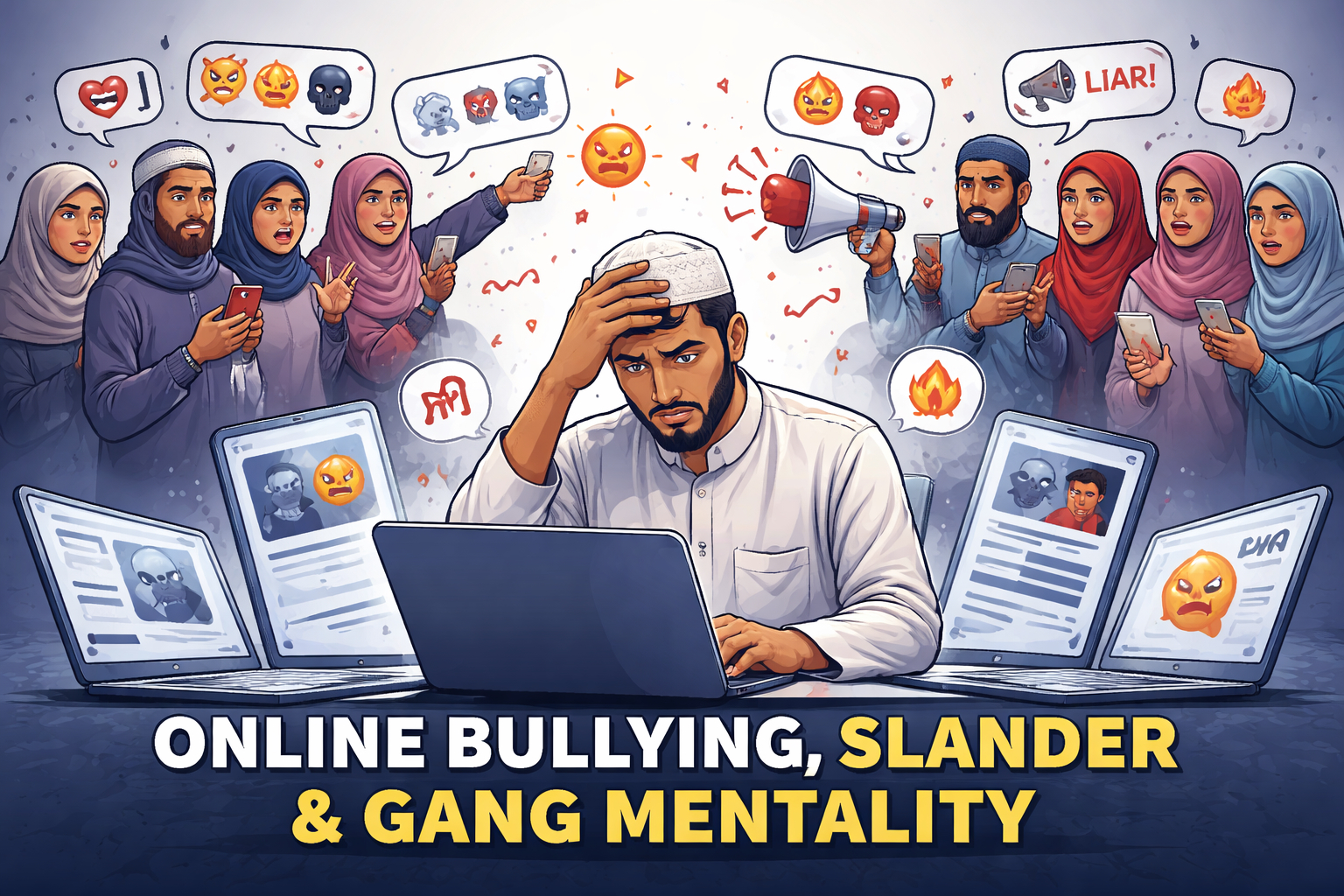
Perhaps the most insidious threat in today’s social media landscape is Gang Mentality—when groups coordinate to harass, intimidate, or “cancel” an individual. Unlike isolated bullying, this involves multiple participants acting together (sometimes unconsciously) to shame or silence someone. These coordinated attacks can begin as collective criticism and quickly descend into vicious targeting.
Gang mentality often arises in tightly knit online communities, where group loyalty trumps fairness. The mob feels justified by a sense of moral superiority or emotional outrage. However, when emotion replaces justice, innocent people are frequently caught and destroyed in the process.
Forms and Tactics of Digital Mob Behaviour
Gang mentality manifests in two main forms:
- Direct attacks: open insults, public accusations, or group trolling designed to break your confidence.
- Indirect attacks: subtler but equally damaging—private group chats, whisper campaigns, or “concerned” posts that shame without naming.
Both can erode your credibility even if no explicit falsehood is shared. The damage occurs through implication and association rather than outright defamation.
For professionals, this can devastate a career. For individuals seeking marriage or building trust in faith communities, it can completely distort their identity in the eyes of others.
Recovering from Digital Hostility
When facing coordinated harassment, your first action must be organisation. Document patterns of behaviour across different accounts and platforms. Identify whether the harassment stems from one source or a coordinated group. Patterns are powerful evidence if you choose to escalate the matter legally or through community mediation.
Second, avoid engaging with mob dynamics. These groups thrive on reaction—your emotional response fuels their narrative. Instead, step back and allow facts, documentation, and time to reveal the truth.
Seeking neutral mediation through trusted community figures can also help. For Muslims, consulting scholars, counsellors, or professionals familiar with Shariah and civil ethical standards can restore fairness and perspective. MMS, for instance, emphasises respect, transparency, and verified integrity through features like ProfileShield™ and DynamIQ Guardian™, which give members control and safety during interactions.
The lesson here is simple: integrity and patience outshine digital hysteria. Slowness to anger and readiness to forgive demonstrate true strength. Even in moments of injustice, responding with faith, evidence, and lawful conduct reaffirms your worth.
Faith, Law, and Emotional Intelligence — Building Resilience in the Digital Age
Grounding Yourself Spiritually
When facing online bullying or public humiliation, spiritual grounding becomes essential. Islam teaches the importance of protecting one’s dignity while responding with sabr (patience) and adl (justice). A believer is encouraged not to act from emotion but from principle.
Prophetic wisdom reminds us that every word we utter—or type—is recorded. The same standard applies to those who harm others with their words. This understanding can bring peace even in the face of injustice: ultimate accountability lies with Allah (SWT), not the crowd.
Legal Awareness and Emotional Empowerment
However, faith must be complemented with knowledge. Understanding your legal rights in the UK is crucial. Laws surrounding harassment, defamation, and malicious communications are designed to protect individual dignity and wellbeing.
Additionally, emotional mindfulness is key. Learn to recognise triggers, regulate responses, and build emotional boundaries. Online cruelty often exploits your insecurities; rebuilding self-trust remains the strongest antidote. Platforms like MMS are reshaping online engagement by prioritising verified identities, education, and accountability—creating safer digital spaces aligned with ethical principles.
Practical Tools for Digital Self-Defence
The Triple-Guard Approach
- Verification Before Interaction: Always verify the identity and intention of those who contact you online. Identity tools such as Yoti help reduce catfishing and digital deception.
- Privacy Protection: Limit how much personal or emotional information you share publicly. Transparency doesn’t mean vulnerability.
- Community Accountability: Encourage responsible online behaviour by engaging only with verified, value-driven platforms. Social enterprises like MMS reinvest in safety, education, and wellbeing rather than profit.
Healing Beyond the Harm
Recovery from online humiliation takes time, especially when connection and reputation matter deeply. Reclaim your narrative through consistent truthfulness and contribution. Share educational content rather than emotional rebuttals. Reconnect with supportive communities rooted in compassion, fairness, and faith.
Ultimately, you are not defined by false narratives; you are defined by your response to them. Let your grace, patience, and evidence speak louder than their accusations. Over time, truth stabilises, and lies collapse under their own weight.
Conclusion: Restoring Dignity and Justice Online
In the digital era, words can heal or harm, uplift or destroy. Whether it’s Bullying, Slander, or Gang Mentality, the path to protection lies not only in technology but in ethics, faith, and emotional intelligence. By combining firm documentation, calm professionalism, and grounded spirituality, you reclaim control over your reputation and future.
Every click, comment, and post becomes a reflection of who we choose to be. Instead of responding with panic or retaliation, respond with principle. Refrain from aggression, seek justice through lawful means, and stand firm in truth.
Digital storms will pass—but your integrity, if protected with discipline and prayer, will endure.