

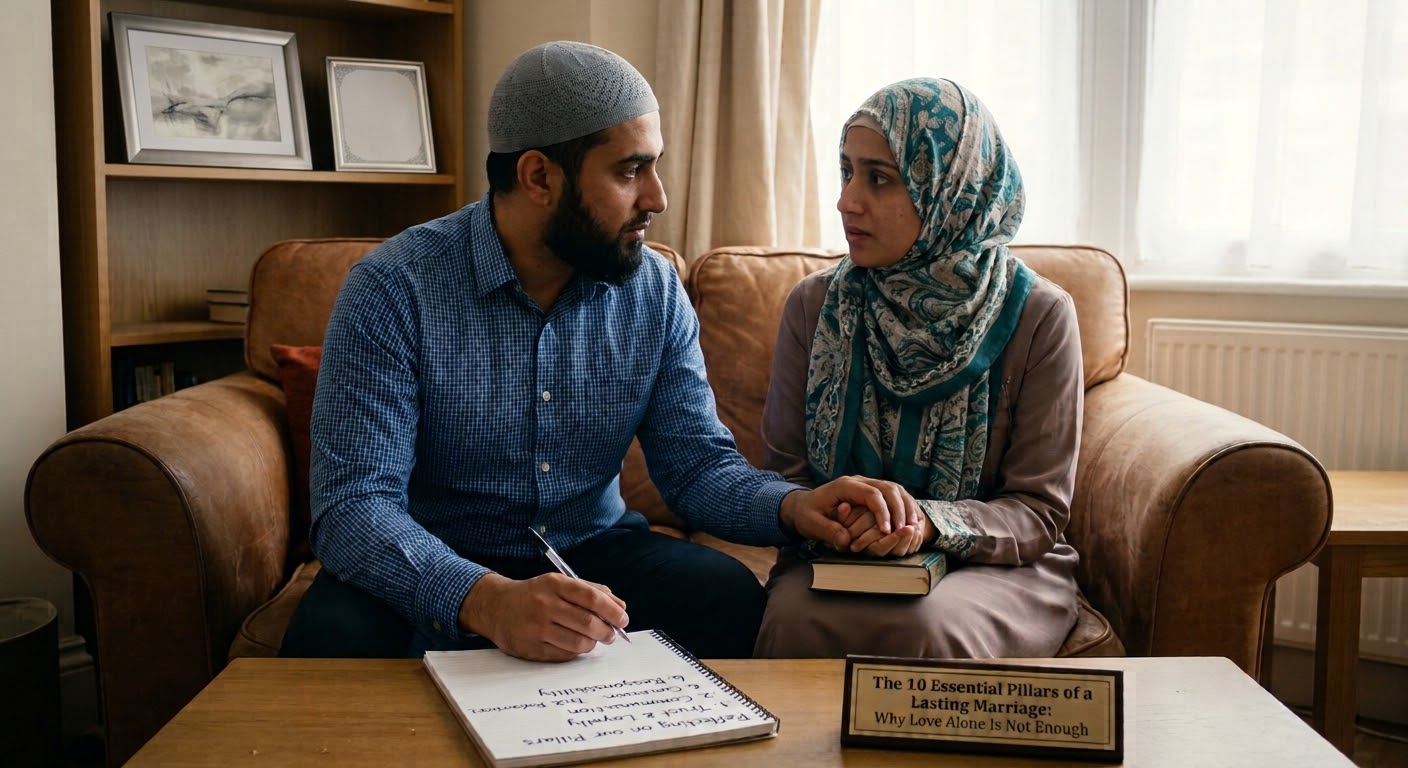
Marriages don’t collapse overnight. More often, they erode slowly when the foundations that hold two people together are neglected or missing.
Marriage is one of life’s most significant commitments. It brings together two individuals, two families, different experiences, expectations and personalities, with the intention of building a shared future.
Many people enter marriage believing that love is enough to sustain the relationship. Love is undoubtedly important, but love alone cannot carry a marriage through every challenge. Feelings can fluctuate, circumstances can change, and life will inevitably present difficulties that test even the strongest relationships.
A successful marriage requires much more than romantic attraction. It needs trust, communication, respect, patience, shared responsibility and a commitment to growing together.
From an Islamic perspective, marriage is also a sacred commitment. Allah ﷻ describes marriage in the Quran as a source of tranquillity, affection and mercy:
“And among His signs is that He created for you spouses from among yourselves so that you may find comfort in them. And He has placed between you affection and mercy.” (Quran 30:21)
These qualities provide an important starting point for understanding what makes a marriage endure.
Here are ten essential pillars that can help couples build a relationship capable of withstanding the challenges of life.
1. Trust and Loyalty: The Foundation of Emotional Security
Trust is arguably the most important foundation of any marriage. Without it, even the smallest disagreement can become a source of anxiety, suspicion and insecurity.
Trust means knowing that your spouse is honest with you, respects your relationship and remains committed to the promises made when you married.
It also means being dependable. If you say you will do something, make every reasonable effort to follow through. If you make a mistake, acknowledge it rather than attempting to conceal it.
Loyalty extends beyond physical fidelity. It includes emotional boundaries, protecting your spouse’s dignity when they are not present, and refusing to entertain situations that could undermine the relationship.
In today’s digital world, loyalty also includes responsible behaviour online. Secretive communications, inappropriate relationships and deliberately concealed activities can gradually undermine confidence between spouses.
Trust is not established through demands for constant access to someone’s private life. It develops through consistent honesty, transparency and responsible behaviour.
Once trust has been damaged, rebuilding it can take considerable time. Both partners must be willing to demonstrate through their actions that the relationship deserves another chance.
2. Effective Communication: Learning to Listen as Well as Speak
Many marital problems are not necessarily caused by a lack of love but by a failure to communicate effectively.
Some couples stop discussing their feelings. Others avoid difficult conversations because they fear confrontation. Over time, unresolved frustrations can become resentment.
Effective communication means being able to express concerns without humiliating or attacking your partner.
It also means listening. Listening is not simply waiting for your turn to speak. It involves genuinely trying to understand what your spouse is experiencing, even when you disagree with their perspective.
For example, instead of saying, “You never listen to me,” explain what has made you feel unheard and what you would appreciate changing.
Couples should also make time for conversations that have nothing to do with bills, children, household responsibilities or everyday administration.
Ask each other how you are feeling. Discuss your ambitions, concerns and expectations. Make room for meaningful conversations.
A marriage becomes stronger when both individuals feel that their voices matter.
3. Shared Values and Goals: Building a Future in the Same Direction
Attraction may bring two people together, but shared values can help keep them moving in the same direction.
Before marriage, couples should discuss the things that will shape their future.
These include religious commitment, children, financial priorities, careers, family relationships, lifestyle expectations and where they eventually wish to live.
It is not necessary to agree on absolutely everything. Two individuals can have different interests, personalities and professional ambitions while maintaining a strong marriage.
However, fundamental differences in values and expectations should not be ignored.
For example, one person may want children while the other does not. One may expect to support elderly parents financially, while the other may have entirely different expectations about family responsibilities.
These are not minor details.
Discussing such matters before marriage can prevent considerable disappointment later.
Shared goals provide a sense of direction. They remind couples that they are not simply living alongside each other but working towards a future together.
4. Mutual Respect: Treating Each Other with Dignity
Respect should never disappear simply because two people become comfortable with one another.
Unfortunately, familiarity can sometimes lead to behaviour that would never have been considered acceptable during courtship.
Sarcasm, insults, public humiliation, dismissive comments and constant criticism can gradually damage a relationship.
Mutual respect means recognising that your spouse is an individual with their own thoughts, feelings, ambitions and boundaries.
It means disagreeing without being disrespectful.
It also means recognising each other’s contributions, whether financial, domestic, emotional or otherwise.
A person’s worth should never be measured exclusively by their income, education, appearance, age or professional status.
Islam places considerable importance on good character and the fair treatment of others.
Marriage should not become a competition over who has greater authority or whose contribution is more valuable.
A healthy relationship recognises that both individuals deserve dignity.
Remember, how you treat your spouse during a disagreement can have a lasting impact long after the disagreement itself has been resolved.
5. Commitment and Patience: Choosing Each Other Through Difficult Times
Every marriage experiences difficult periods.
There may be financial pressures, professional setbacks, family disagreements, health challenges, parenting difficulties or unexpected changes in circumstances.
There will also be moments when partners feel frustrated with one another.
Commitment means recognising that marriage is not simply about enjoying the good times. It is about approaching difficulties together.
Patience is equally important.
Not every disagreement needs an immediate resolution, and not every frustration needs to become an argument.
Sometimes, taking a step back, allowing emotions to settle and returning to a discussion later can prevent unnecessary damage.
However, patience should never be confused with accepting abuse, intimidation or persistent mistreatment.
A healthy marriage requires both individuals to take responsibility for their behaviour and make a genuine effort to improve.
Commitment is demonstrated through everyday actions: showing up, keeping promises, offering support and continuing to invest in the relationship.
6. Shared Responsibility: Marriage Is a Partnership
A marriage should not become an arrangement in which one person carries every responsibility while the other simply benefits.
Successful couples understand the importance of working together.
Responsibility can include managing household finances, raising children, maintaining the home, supporting elderly relatives and providing emotional reassurance.
The precise division of responsibilities will differ between couples, depending on their circumstances, abilities and agreed arrangements.
Islamic marriage also recognises rights and responsibilities for both spouses.
Financial responsibilities, for example, have specific Islamic considerations. These should be understood rather than casually dismissed or replaced by assumptions.
Equally, couples should appreciate that financial contributions are not the only contributions that matter.
Someone who manages a household, raises children or provides emotional support is making a meaningful contribution to family life.
The important principle is that neither spouse should feel taken for granted.
Discuss expectations openly. Agree on practical arrangements and revisit them when circumstances change.
A marriage becomes stronger when both partners recognise that they are working towards a common purpose.
7. Forgiveness: Learning to Move Forward Without Repeating the Past
No human being is perfect.
Everyone makes mistakes, says things they regret and occasionally falls short of expectations.
In marriage, disagreements are inevitable. What matters is how couples respond when they hurt one another.
Forgiveness allows individuals to move beyond genuine mistakes rather than allowing every disagreement to become another entry in a growing list of grievances.
However, forgiveness is not the same as pretending that nothing happened.
An apology should involve acknowledging the harm caused, accepting responsibility and demonstrating a willingness to change.
Equally, the person offering forgiveness must make a genuine effort not to weaponise an issue that has been sincerely resolved.
Repeatedly bringing up old mistakes can prevent a relationship from moving forward.
Islam places great importance on forgiveness, mercy and compassion.
Nevertheless, forgiveness does not require someone to remain in an unsafe or abusive situation.
Where serious harm has occurred, appropriate boundaries, accountability and professional support may be necessary.
The objective should be to establish a healthier relationship, not simply to restore appearances.
8. Intimacy and Affection: Keeping Emotional and Physical Closeness Alive
Intimacy is an important part of marriage, but it extends beyond physical relations.
It includes affection, companionship, emotional availability and the ability to feel comfortable and appreciated in each other’s company.
Small gestures can make a considerable difference.
A thoughtful message, a compliment, holding hands, spending quality time together or simply asking how your spouse’s day went can reinforce emotional closeness.
Physical intimacy should also be approached with mutual consideration, respect and sensitivity to each other’s needs.
Couples should be able to discuss intimacy without embarrassment, hostility or unnecessary judgement.
Life circumstances can affect intimacy. Parenthood, stress, illness, ageing and professional responsibilities can all influence a couple’s relationship.
Rather than allowing these changes to create emotional distance, couples should communicate and find ways to maintain their connection.
Never assume that affection becomes less important simply because you have been married for many years.
Your spouse should continue to feel wanted, appreciated and valued.
9. Spiritual Growth: Strengthening Your Connection with Allah ﷻ
For Muslim couples, marriage provides an opportunity to grow spiritually as well as emotionally.
Faith can provide guidance, reassurance and a shared moral framework during difficult periods.
Praying together, encouraging one another to fulfil religious obligations, reading the Quran and attending beneficial Islamic gatherings can help strengthen this connection.
Spiritual growth should be approached with encouragement rather than superiority.
Neither spouse should use religion as a weapon to belittle, control or intimidate the other.
Instead, both should encourage one another towards goodness, understanding and better character.
A marriage rooted in faith should reflect compassion, honesty, patience and responsibility.
It should also recognise that both individuals are continually learning and developing.
There is something particularly meaningful about having a spouse who encourages you to become a better Muslim while also supporting your personal growth.
Marriage is not simply about building a household together. It can also be about helping one another prepare for the Hereafter.
10. Humour and Playfulness: Never Underestimate the Power of Laughter
Marriage is a serious commitment, but that does not mean the relationship should become serious all the time.
Laughter is an important part of companionship.
Being able to joke together, share amusing experiences and enjoy each other’s company can help couples navigate the pressures of everyday life.
Humour can also diffuse tension, provided it is used sensitively.
There is a significant difference between laughing together and making your spouse the subject of humiliation.
Couples should develop their own shared experiences, traditions and memories.
It might be an evening walk, a favourite television programme, a holiday, cooking together or simply laughing about something that happened during the day.
These seemingly ordinary moments often become some of the most treasured memories of married life.
Never allow the responsibilities of adulthood to eliminate the friendship that should exist between husband and wife.
A lasting marriage should contain companionship as well as commitment.
Building a Marriage That Lasts: The Importance of Getting the Foundations Right
The ten pillars discussed above are not independent ingredients that can simply be added to a relationship whenever problems arise.
They are interconnected.
Trust supports communication. Respect makes forgiveness possible. Shared values strengthen commitment. Spiritual growth encourages better character, while affection and humour help preserve companionship.
Most importantly, these qualities should not only be considered after marriage.
They should form part of the conversations people have when deciding whether someone is the right person to marry.
Too often, people concentrate heavily on attraction, appearance, professional status, income or family background while overlooking the qualities that will determine whether they can build a successful life together.
These matters may have their place, but they cannot substitute for character, compatibility and mutual responsibility.
It is also important to recognise that nobody enters marriage as a finished product. Both individuals will continue to grow, learn and change.
The strongest marriages are not necessarily those without disagreements. They are those in which both partners are willing to address difficulties, take responsibility and work towards a healthier relationship.
Love matters, but it is the foundations beneath it that help it last.
Muslim Marriage Services: Building a Marriage Sanctuary Around Trust
At Muslim Marriage Services (MMS), we believe that the foundations of a successful marriage begin long before the wedding day.
Our mission is to help create a more responsible, secure and supportive environment for Muslims seeking a life partner.
We are a Certified Social Enterprise, built around the principles of trust, digital security and Shariah-compliant guidance.
Our approach places particular emphasis on identity verification and safety. Through Yoti digital identity verification, fraud screening and administrative approval, we aim to establish greater confidence in the people entering our community.
We also recognise that successful marriage is about more than introducing two individuals.
It involves encouraging transparency, informed decisions, responsible conduct and an appreciation of the responsibilities that come with marriage.
Our wider vision includes supporting individuals and families through a more considered approach to Muslim marriage, with appropriate guidance and safeguarding features.
We are currently inviting expressions of interest for our Founding 200 community.
This is an opportunity for serious individuals to express an interest in helping shape the future of a Muslim marriage service built around trust, responsibility and digital security.
We are not competing on numbers. We believe that trust, security and responsibility should come first.
If you believe Muslim marriage deserves a more thoughtful and secure approach, we would welcome your interest.
Comment “Pioneer” below or send us a direct message to express your interest in the Founding 200.
Muslim Marriage Services (MMS) — Love Built on Trust & Digital Security™.