
 The Choice We Rarely Name, Yet Always Feel
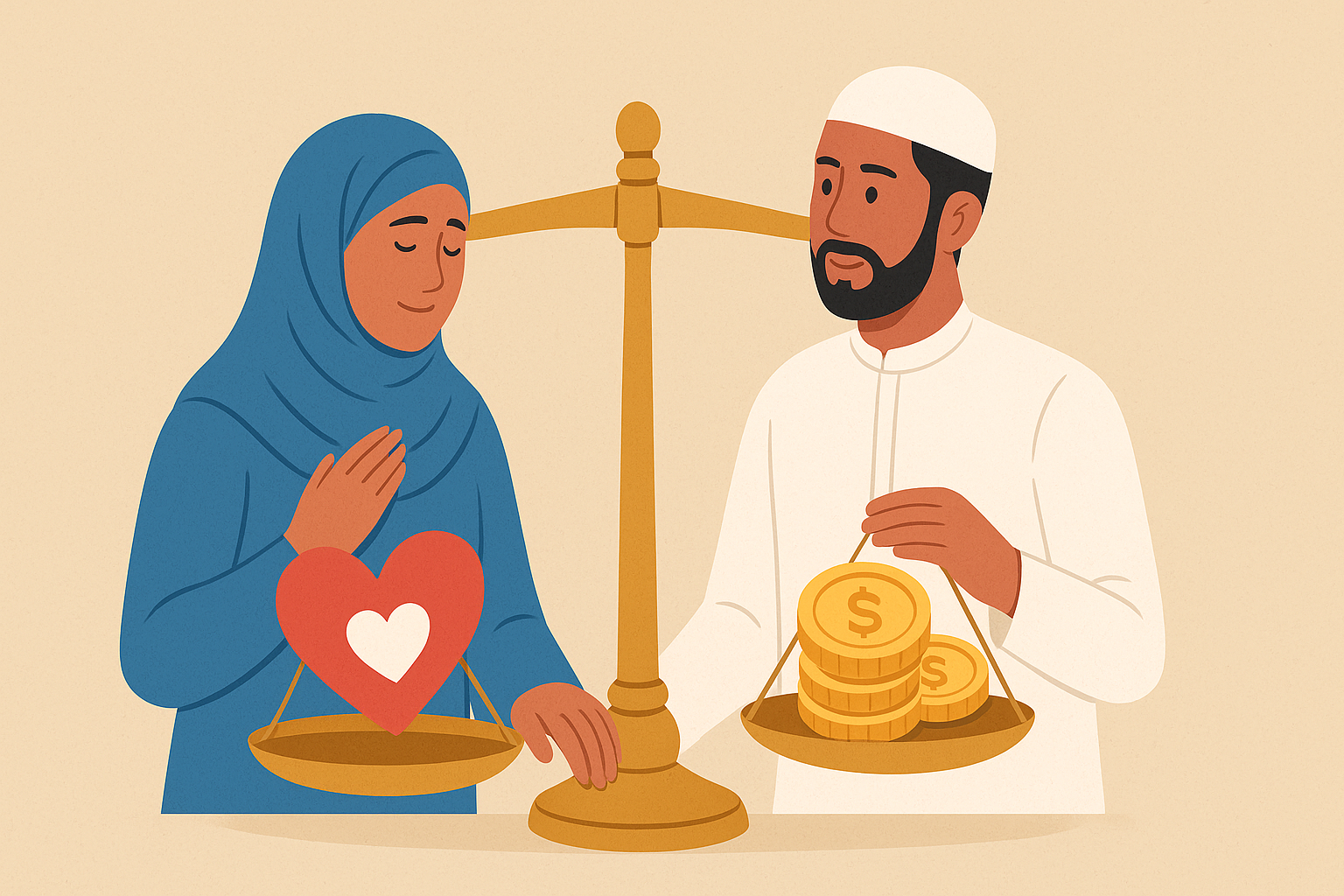
If you had to choose between emotional security or financial stability in a marriage, which would you pick? It is an uncomfortable question because in a healthy marriage we want both. Yet, in real life, choices, pressures, and timing often force us to lean in one direction. Many people assume money solves everything. However, even comfortable bank balances cannot compensate for a lack of trust, poor communication, or emotional neglect. Equally, deep affection without a plan for bills, savings, or emergencies can strain even the strongest bond.
In this article, we unpack Emotional Security vs Financial Stability through a Muslim lens, guided by Islamic principles and the practical needs of modern life. We also share tools, questions, and safeguards that support both hearts and households—so couples not only marry well, but live well together, insha’Allah. As a Certified Social Enterprise, Muslim Marriage Services (MMS) is built for this exact balance: trust, safety, education, and dignity, combined with smart, Shariah-compliant innovation.
The Core Question Behind the Aisle
Many of us quietly ask: do I choose someone who makes me feel safe, seen, and supported—or someone who provides material stability, planning, and security for the future? The truth is, both matter. Emotional security means you can rely on your partner’s character, patience, and compassion. Financial stability means you can rely on a plan when life shifts—job changes, children, caring for parents, or unexpected costs. One anchors your heart; the other steadies your life.
However, emotional security often deserves priority because it is the soil where everything else grows. When couples feel safe, listened to, and respected, they can discuss budgeting without blame, face redundancies without despair, and make compromises without resentment. Money reduces stress; it does not create meaning. Meaning comes from trust, mercy, and good character—qualities our tradition elevates above wealth.
At the same time, it would be naïve to downplay the power of financial stress. In the UK, the cost of living, housing, and childcare can push even loving couples into conflict. Financial strain can lead to secrecy, avoidance, and mistrust—especially when expectations were never discussed. Therefore, wise couples prioritise emotional security while deliberately building financial stability. This is not a choice between soul and salary; it is a commitment to both.
What Emotional Security Actually Looks Like
Emotional security is not vague sentiment; it is a set of behaviours you can observe. It sounds like consistent follow-through, calm problem-solving, and sincere apologies when mistakes happen. It looks like respect for your boundaries, kindness in private and public, and reassurance in times of anxiety. It feels like the confidence that your partner’s words and actions align.
Moreover, emotional security rests on Islamic ethics: trustworthiness (amanah), excellence (ihsan), patience (sabr), and God-consciousness (taqwa). When couples practise adab in their daily interactions—listening before responding, avoiding mockery, managing anger, and giving the benefit of the doubt—they create a climate where conflict produces growth, not harm. Such couples are not conflict-free; they are conflict-competent.
You can intentionally build emotional safety before and after nikah. Before marriage, have purposeful conversations about values, roles, family involvement, expectations around work and children, and how you each handle stress. After marriage, schedule regular check-ins—short weekly catch-ups or monthly reviews—to share appreciation, discuss concerns, and realign goals. Emotional security grows from small, consistent acts of care.
Financial Stability—Beyond the Payslip
Financial stability is more than a number on a spreadsheet. It includes predictable income, disciplined budgeting, clear debt strategies, emergency savings, and agreed responsibilities. It also includes the skills to adapt when circumstances change—career shifts, health issues, or moving home. Financial stability, therefore, is not wealth; it is readiness.
In Islamic terms, it includes the husband’s responsibility for maintenance, the importance of mahr as dignity and security, and the encouragement of fairness and generosity within families. However, modern realities require detail: how will you manage household expenses? Will you pool income, split costs, or operate a hybrid approach? What if one spouse studies, cares for children, or takes career breaks? What is your joint stance on debt and halal investment?
Financial stress often comes from ambiguity rather than poverty. Couples can earn well yet argue constantly because roles are unclear or expectations are mismatched. Conversely, couples on modest incomes can thrive because they communicate and plan. Thus, couples should treat financial planning as an expression of mercy and partnership, not a transaction. You are not budgeting against each other; you are budgeting for each other.
Real-Life Family Context—Same Roots, Different Weather
Within the same family, siblings can live completely different stories. One couple may enjoy both emotional and financial stability—two incomes, supportive in-laws, and strong communication. Another couple may be emotionally close yet financially stretched, relying on the wife’s family for rent top-ups or childcare. This does not make either couple better; it highlights that marriages are ecosystems shaped by more than love or earnings alone.
Financial reliance on extended family can be a blessing or a burden. It can provide breathing room during transitions; it can also create pressure, expectations, or subtle power imbalances. Emotional security helps couples navigate these dynamics—by setting respectful boundaries, showing gratitude, and protecting each other’s dignity. Financial planning helps them move towards independence—gradually building savings, diversifying income, or relocating to more affordable areas.
Every family context carries unique tests: cultural expectations, health needs, elderly care, migration journeys, and community pressures. The question is less “Who has it easiest?” and more “How do we manage our reality with ihsan?” Couples who combine compassion with structure make better decisions and carry less resentment. They also model resilience for younger relatives watching closely.
Why Safety and Trust Matter in the Digital Age
Today’s marriage search often begins online, which introduces both opportunity and risk. Genuine suitors can connect across cities and professions. Yet romance fraud is a growing threat, with UK victims losing over £100 million in 2024 according to City of London Police. For Muslims seeking a halal path to marriage, safety is not optional—it is part of amanah.
This is why MMS verifies every member via our biometrics partner Yoti, a Certified B Corporation and global leader in AI identity solutions. Verification protects dignity and deters deception. Furthermore, MMS’ DynamIQ Guardian allows mahram or trusted guardians to discreetly oversee interactions, and ProfileShield enables secure profile sharing with optional guardian approval. These tools reinforce trust where it matters most.
Emotional security begins with knowing who you are speaking to. Financial stability begins with avoiding costly mistakes. Safe platforms, transparent processes, and guardian involvement help couples focus on compatibility rather than anxiety. In a world of filters and false names, identity assurance is a mercy.
Integrating Heart and Household—A Practical Blueprint
Couples who thrive blend emotional literacy with financial clarity. They talk openly, plan consistently, and course-correct quickly. They know that love without structure becomes chaos, and structure without love becomes cold. Therefore, successful marriages develop routines that nurture both the heart and the home.
Try monthly “marriage meetings” with a simple agenda. Start with gratitude: what did you appreciate about your spouse this month? Move to practical matters: budget updates, upcoming expenses, family commitments, and career changes. End with connection: a small plan for quality time, spiritual growth, or a shared project. Keep the tone constructive. Celebrate wins, learn from misses, and confirm next steps.
Furthermore, design your financial system together. Agree how income flows, who pays what, and when you review. Set a starter emergency fund, then build towards three to six months’ essentials. If one spouse pauses work for childcare or study, recognise non-financial contributions and plan fair allowances. Make money a shared language, not a taboo.
Pre-Nikah Conversations—Questions That Save Tears Later
Before you say yes, prioritise clarity. These questions help couples assess Emotional Security vs Financial Stability and how to balance both over time.
- What does emotional safety look like for you? What behaviours build trust, and what breaks it?
- How do you handle conflict? Do you prefer space or immediate discussion?
- What are your expectations around roles, housework, childcare, and elderly care?
- How do you approach money—spender, saver, planner, or avoider?
- What is your current financial picture—income, debts, obligations, and dependants?
- What are your views on joint, separate, or hybrid accounts?
- How will we manage career transitions, study, or time off for parenting?
- What are your boundaries with family involvement and financial requests?
- How do you feel about living with in-laws, and for how long if needed?
- What are your short- and long-term financial goals—home, Hajj/Umrah, business, charity?
- What are your non-negotiable Islamic practices and lifestyle expectations?
- How will we keep learning—premarital courses, counselling, or mentorship?
- How will we protect each other’s dignity online and offline?
- What is our plan if either of us faces redundancy, illness, or debt?
- How will we make decisions when we disagree?
These conversations are not interrogations; they are investments. The aim is not perfect answers but honest ones. When couples map expectations early, they reduce conflict later.
Red Flags and Green Flags—Spot Early, Respond Wisely
Because Emotional Security vs Financial Stability often hinges on habits, you can watch for patterns that either protect or endanger the marriage.
Green flags
- Consistency between words and actions
- Respectful disagreement without stonewalling or mockery
- Willingness to disclose financial realities and plan together
- Care for your boundaries, time, and dignity
- Positive involvement of guardians or mahram when appropriate
- Openness to seek counselling or education when needed
Red flags
- Love-bombing, secrecy, or pressure to rush commitment
- Financial vagueness, reluctance to discuss debts or obligations
- Disrespectful talk about women or men, or unhealthy jokes about marriage
- Controlling behaviour masked as “protection”
- Reluctance to verify identity or include trusted guardians
- Dismissing Islamic obligations or weaponising them for control
Respond with clarity and boundaries. Ask direct questions. Involve a trusted elder or counsellor. If trust cannot be established, step away with dignity. Protecting your future is not harsh; it is wise.
Education, Community, and Tools That Help
MMS does more than introductions. We educate, safeguard, and support Muslims throughout the marriage journey. As a Shariah-compliant, Certified Social Enterprise, our mission is to strengthen the ummah by combining ethical design with practical tools.
- Safety and ethics: We verify identity via Yoti, protect interactions through DynamIQ Guardian, and enable controlled sharing with ProfileShield.
- Meaningful matches: Our Islamic Compatibility Matching highlights values and life goals, while user autonomy ensures transparent, halal engagement.
- Education and support: We offer premarital education, post-marital coaching, and counselling to build communication and conflict skills.
- Financial inclusion: Our Marriage Fund provides targeted support for those unable to afford essential wedding costs, reducing barriers and cultural pressure.
Guided by our Guardian Council, led by an experienced female Shariah scholar and global family solicitor, we ensure that practice aligns with principle. We also engage with Christian communities to build shared understanding—because strong families benefit wider society. Under the leadership of Hajji Mostafa, MMS continues to set high standards in trust, security, and innovation.
When Money Disagrees With the Heart—Making Better Trade-offs
Sometimes life confronts you with unbalanced options: a partner who makes you feel safe but is rebuilding finances, or a high earner who struggles with empathy and consistency. Resist the temptation to ignore what your body and conscience are telling you. Emotional safety is not a luxury; it is a basic need. Financial stability can be built; character is slower to change.
That said, do not romanticise hardship. Chronic financial strain can erode even healthy relationships. If you consider marrying while one or both of you are not yet stable, agree on a realistic timeline, budget, and milestones. Involve trusted elders or mentors who will support you rather than shame you. Seek halal opportunities, build marketable skills, and plan for resilience.
The goal is not perfection. It is a trajectory you both trust—where your marriage strengthens your iman, steadies your emotions, and equips your household to weather storms.
Practical Habits That Combine Love and Provision
To integrate Emotional Security vs Financial Stability, cultivate habits that serve both.
- Keep short, frequent check-ins: five to ten minutes several times a week fosters closeness and lowers the temperature on difficult topics.
- Hold monthly finance reviews: simple, consistent reviews beat complex plans you never revisit.
- Agree a conflict process: for example, pause, summarise, ask, propose. Pauses prevent escalation; summaries ensure understanding; proposals move you forward.
- Build a shared safety net: automate savings to protect against shocks and reduce fear during disagreements.
- Protect privacy and dignity: agree on social media boundaries, photo sharing, and family disclosures.
- Learn together: read one marriage book each quarter, attend a course, or seek counselling before problems harden into patterns.
These practices turn aspiration into rhythm. Over time, rhythm becomes culture—your family way of being.
The Digital Trust Factor—Why Verification Supports the Heart
Trust is emotional, but it thrives on evidence. When you know a platform screens identities and gives you tools to involve a guardian, you can relax into authentic conversation. You spend less time verifying and more time understanding values, goals, and temperament.
By partnering with Yoti for digital ID verification, MMS reduces risk and restores dignity. Our optional DynamIQ Guardian feature invites trusted oversight without intrusion, while ProfileShield allows secure, limited sharing so you remain in control. Together, these features reflect a simple truth: when we reduce risk, love gets space to grow.
Community Resilience—From Individual Choices to a Stronger Ummah
Marriage is personal, but its ripple effects are communal. When couples marry well, communicate, and plan responsibly, they build stable homes for children, lighten pressure on extended families, and uplift community morale. Conversely, rushed decisions, secrecy, and unaddressed debt can feed cycles of conflict and disillusionment.
As a community, we can create better conditions: normalise premarital education, champion identity verification and guardian involvement online, and make modest nikahs culturally celebrated rather than judged. We can also support young professionals, reverts, and those in their late 20s and 30s with practical networking and mentoring, not just criticism or unrealistic lists.
Final Reflections—Choose the Heart, Plan the Pounds
So, if you had to choose, which would you pick? Emotional security or financial stability? If pressed, choose the heart—but do not neglect the plan. Marry someone whose character you trust, and then become a team who manages money with transparency and mercy. In this balance lies resilience. In this balance lies sakinah, tranquillity.
Understanding this distinction early helps couples set wise priorities. Focus on emotional connection to build a foundation that can carry your finances. Then, use sound planning to protect that bond from unnecessary stress. Emotional and financial wellbeing are not rivals—they are allies when nurtured with intention.
Which do you focus on more in your relationships—emotional connection or financial planning? Comment below and follow MMS for more guidance on building deeper, stronger, and lasting relationships. Ameen.